
logo
Viewpoint

AI collaborative creative workflow: providing new digital solutions for public welfare communication and interaction H5

AI collaborative creative workflows: providing customers with faster, richer and more powerful digital solutions


Project address https://www.stoyard.com/works/ 421
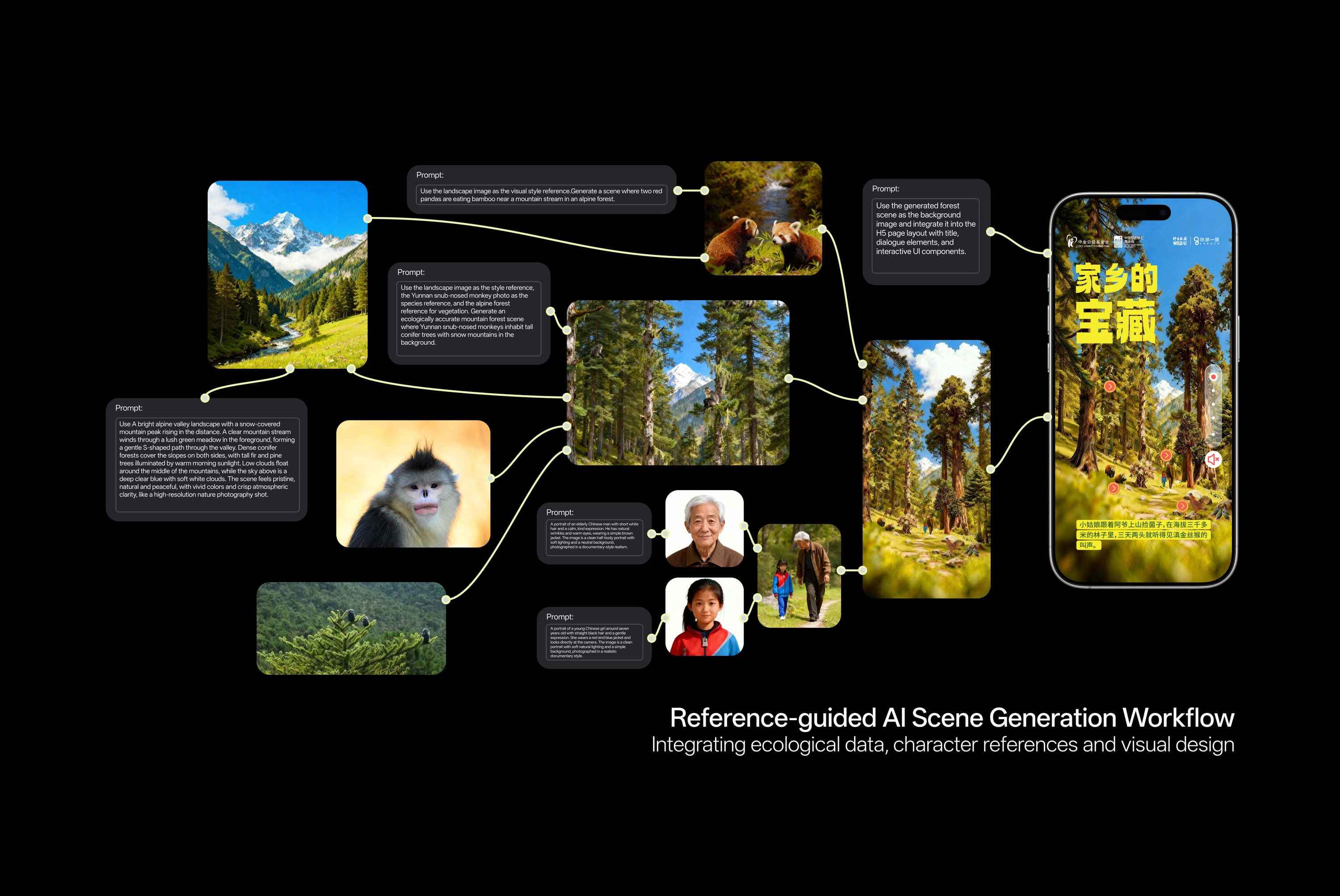


AI tools are changing the way design companies work, but the real change is not simply to generate a few images with AI, but to integrate AI into the complete creative workflow.

For brand communication, public welfare communication, interactive H5, digital exhibition and content-based websites, what customers need is not just visual effects, but a set of solutions that can quickly understand the theme, generate direction, verify style, organize content and complete delivery.



中国慈善家2021年度公益机构| 野生救援:让公益“出圈” - 中国慈善家


Taking the "I Love My Hometown" interactive H5 project of the Wild Rescue WildAid as an example, STOYARD introducing AI generation technology in the project to work with the design team, combining ecological knowledge, natural scenes, public welfare communication and interactive experience, it provides customers with a more efficient and flexible digital content production method.


1. AI collaboration is not a substitute for design, but an extension of creative capacity


In traditional projects, visual exploration often requires multiple stages such as data collection, style setting, sketch attempts, illustration drawing, dynamic testing, and page integration. Especially for natural ecological projects, visual content needs to present geography, climate, species, plants, environment and emotions, with high production costs and long iteration cycles.

The addition of AI tools allows the design team to enter the visual exploration phase faster.

In the I Love My Hometown project, STOYARD use AI generation technology as a collaborative tool for visual production. AI is not only a tool to improve efficiency, but also a "new brush": it helps the team to quickly simulate natural images, explore the picture atmosphere, generate a variety of scene possibilities, and then be screened, reconstructed and systematically integrated by designers.

This approach transforms the creative process from a single linear production to a multi-directional exploration under human-machine collaboration.


2.'s journey from ecological data to senses: AI helps complex information be perceived more easily


Public welfare communication and ecological communication often face a difficult problem: the content is very important, but the information is very complex.

The distribution of natural resources, climate knowledge, biodiversity, species protection and other content, if only words and data are used to express, it is difficult for users to generate sustained interest. Therefore, the task of design is not simply to explain knowledge, but to transform knowledge into an emotional, rhythmic, and participatory experience.

In this project, the STOYARD set the narrative origin as "children's perspective", and used a closer and warmer observation method to compare the magnificent nature of the "three parallel rivers" in northwest Yunnan with the "snow mountain elf" Yunnan golden monkey. The sense of life is connected.

The value of AI tools here is to help teams quickly build rich natural scenes, so that macro-ecological knowledge no longer stays at the abstract level, but becomes a digital journey that users can see, feel and participate in.


3. AI generation vision must enter a unified brand and UI system


The problem with many AI visual works is that the single picture is very good-looking, but it lacks systematicness in real projects.

For customer projects, the page should not only have pictures, but also brand consistency, interactive readability, information level and communication stability. Therefore, AI generated content cannot exist in isolation, but must be incorporated into the complete design system.

In the "I Love My Hometown" interactive H5, STOYARD combines AI-generated natural imagery with unified brand colors, interface components, and interactive rhythms through prompt control, style screening, visual reprocessing, and UI system integration.

This not only retains the rich, delicate and imaginative details in the AIGC screen, but also ensures that the final page has a clear information structure and a stable user experience.

This is the key to AI a collaborative workflow: the AI is responsible for expanding the possibilities, and the designer is responsible for judging, organizing and landing.


4. use AI to build nature scenes that are difficult to shoot or unify


Ecological projects often encounter practical limitations: some scenes are difficult to photograph, some species are difficult to present, and some climate changes are difficult to express in the same visual system.

Northwest Yunnan has a three-dimensional climate landscape of "one mountain with four seasons and ten miles with different days. To simultaneously present snow-capped mountains, forests, river valleys, plants, animals, and climate change in an interactive H5 requires a large amount of visual resources and unified aesthetic control.

With the help of AI generation capability, STOYARD can more efficiently simulate natural scenes across time and space, allowing representative species such as Yunnan snub-nosed monkey, longissima and alpine leek to present a more infectious life texture in digital space.

This kind of ability is especially suitable for public welfare communication, cultural tourism communication, nature education, city brand and cultural content projects. It can help customers get a more complete scene expression within a limited time and budget.


5. AI workflow to upgrade interactive H5 from "page production" to "content experience design"


The value of interactive H5 is not only that the page can be clicked, slid and shared, but also that users can complete cognitive changes in the interaction.

In the "I Love My Home" project, the interactive component is not only a function button, but also a part of the narrative. Users enter the microscopic species world from the macro geographical view, and gradually complete the identity transformation from "observer" to "guardian" by clicking, sliding and exploring.

AI tools are not solely responsible for vision in this process, but participate in the construction of content experience: help the team generate scenes, test atmosphere, expand species picture, enhance emotional expression, and then the design team organizes these materials into interactive, communicable and understandable experience paths.

This way of working makes interactive H5 no longer just an executive page, but a complete digital narrative product.


What can 6. AI collaboration workflows bring to customers?


For customers, AI collaboration isn't just about "plotting faster". The real value lies in the improvement of the overall efficiency and expression ability of the project.

STOYARD AI collaborative creative workflows that help clients:

Faster visual direction exploration
Reduce the production threshold of complex scene content
Enhance the visual richness of public welfare, cultural tourism, ecology and brand communication.
Turn abstract knowledge into a perceptible interactive experience
Complete more creative solution validation in a limited period
Maintain consistency between AI vision and brand system and UI system
More flexible delivery for social media communications, interactive H5 and digital content projects

This type of workflow is especially suitable for nature education, public welfare organizations, international agencies, government communication, cultural tourism brands, urban renewal, cultural exhibitions and social issues communication projects.


In the era of 7. AI, the value of design companies is more important.


AI can generate images, text and solutions, but it does not automatically understand the customer's goals, nor does it automatically determine what content is suitable for communication, what visual fits the brand, and what interactions guide user actions.

Therefore, the value of design companies in the AI era is not whether they can use a certain tool, but whether they can integrate AI into professional methods.

The role of the STOYARD in the project is to organize strategy, narrative, vision, interaction, technology and content production so that AI generation capabilities serve the real project goals. AI expands creative boundaries, while the design team ensures that the final solution is clear, accurate, usable and communicable.


Conclusion


The "I Love My Hometown" interactive H5 project explains that AI tools can bring customers a new digital solution: it makes complex content easier to translate, makes visual exploration more efficient, makes interactive experiences richer, and makes public service communication more infectious.

From ecological data to sensory journeys, from AI generated images to complete UI systems, from natural scene simulations to interactive narrative experiences, STOYARD help customers access more imaginative and communicative digital content in shorter cycles through AI collaborative workflows.

For customers looking for interactive H5, public welfare communication, cultural and tourism digital content, AI visual generation, brand communication and digital experience design, AI collaboration is not just a new tool, but a set of workflows that can redefine creative production methods.


Keywords


AI creative workflow, AI design collaboration, AIGC visual design, interactive H5 design, public welfare communication design, ecological communication H5, digital content solutions, AI visual generation, cultural and tourism interactive experience, brand communication digitization, WildAid interactive H5, STOYARD AI design.