
AI collaborative creative workflow: providing new digital solutions for public welfare communication and interaction H5
Public Welfare Communication/Interactive H5 Digital Solution
Project Address:stoyard.com/works/ 421
AI collaborative ideas to provide customers with faster, richer and more powerful digital solutions
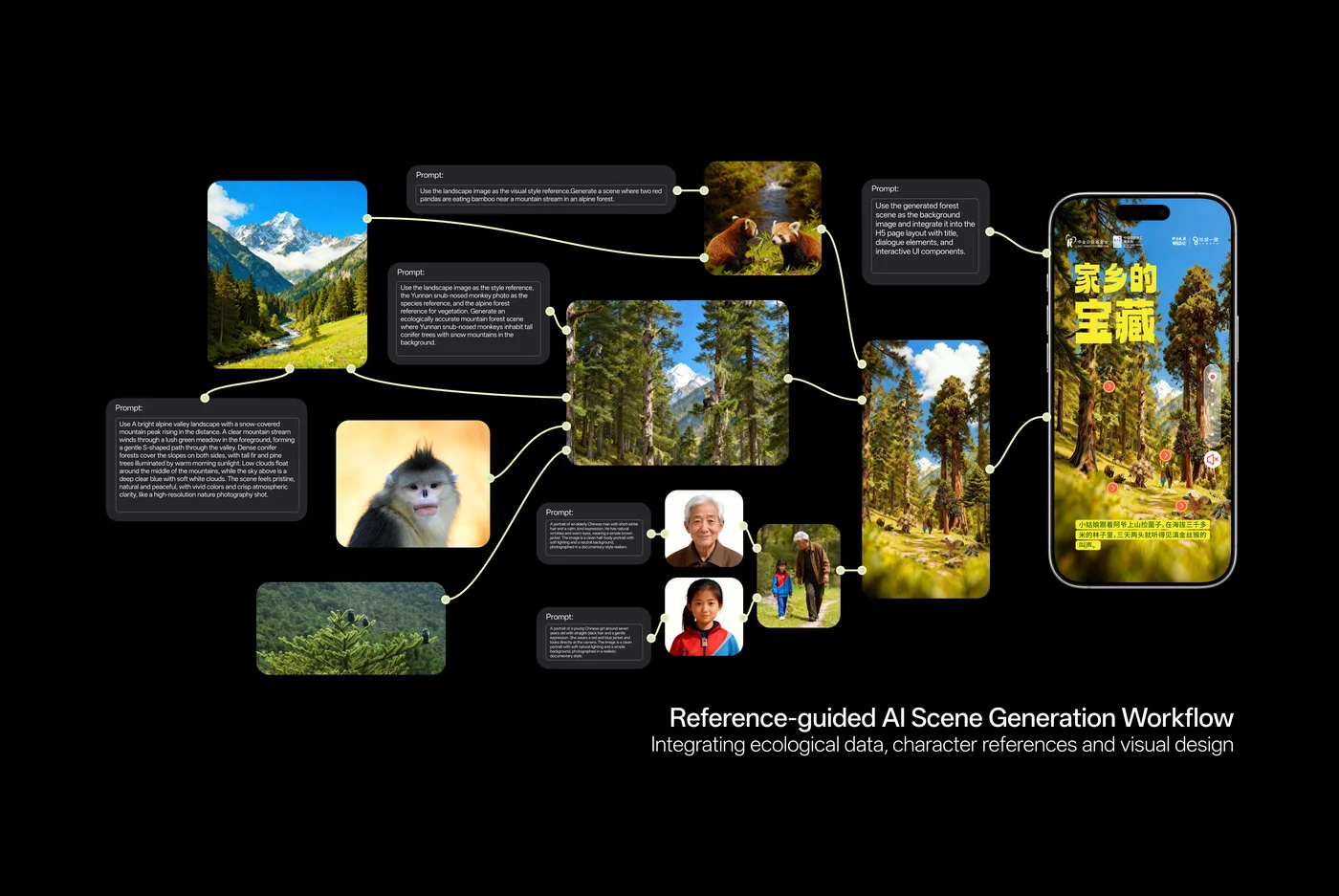
Project cover: wild rescue WildAid "I love my hometown" interactive H5
AI tools are changing the way design companies work, but the real change is not simply to generate a few images with AI, but to integrate AI into the complete creative workflow.
For brand communication, public welfare communication, interactive H5, digital exhibition and content-based websites, what customers need is not just visual effects, but a set of solutions that can quickly understand the theme, generate direction, verify style, organize content and complete delivery.
Taking the "I Love My Hometown" interactive H5 project of the Wild Rescue WildAid as an example, STOYARD introducing AI generation technology in the project to work with the design team, combining ecological knowledge, natural scenes, public welfare communication and interactive experience, it provides customers with a more efficient and flexible digital content production method.
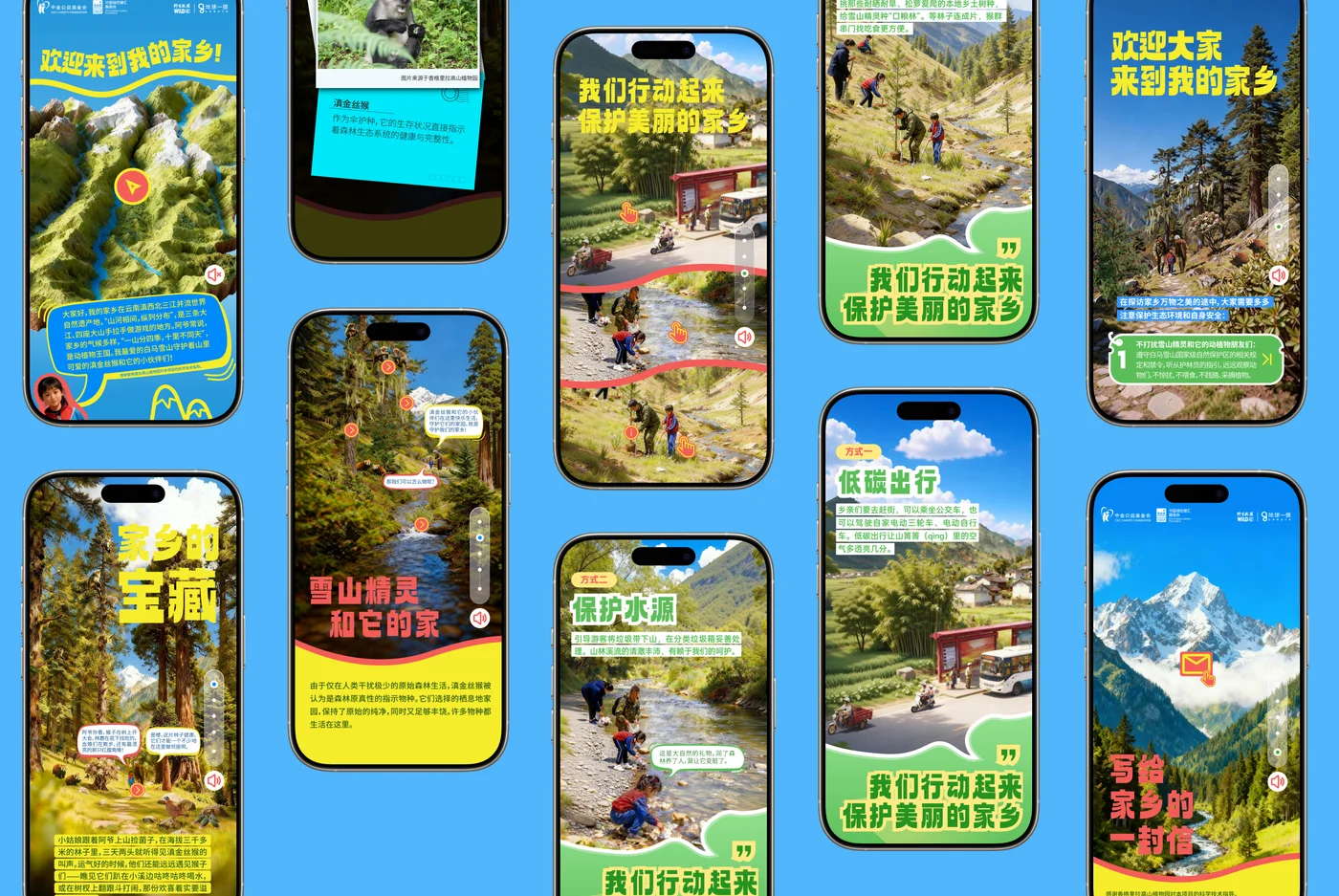
Original project: H5 full-process page overview, covering modules such as geographic navigation, species stories, low-carbon travel and interactive tasks.
AI collaboration is not a substitute for design, but an extension of creative capacity
In traditional projects, visual exploration often requires multiple stages such as data collection, style setting, sketch attempts, illustration drawing, dynamic testing, and page integration. Especially for natural ecological projects, visual content needs to present geography, climate, species, plants, environment and emotions, with high production costs and long iteration cycles.
The addition of AI tools allows the design team to enter the visual exploration phase faster. In the I Love My Hometown project, STOYARD use AI generation technology as a collaborative tool for visual production-it's more like a"New Brush": Help the team to quickly simulate natural images, explore the picture atmosphere, generate a variety of scene possibilities, and then be screened, reconstructed and systematically integrated by designers.
This approach transforms the creative process from a single linear production to a multi-directional exploration under human-machine collaboration.
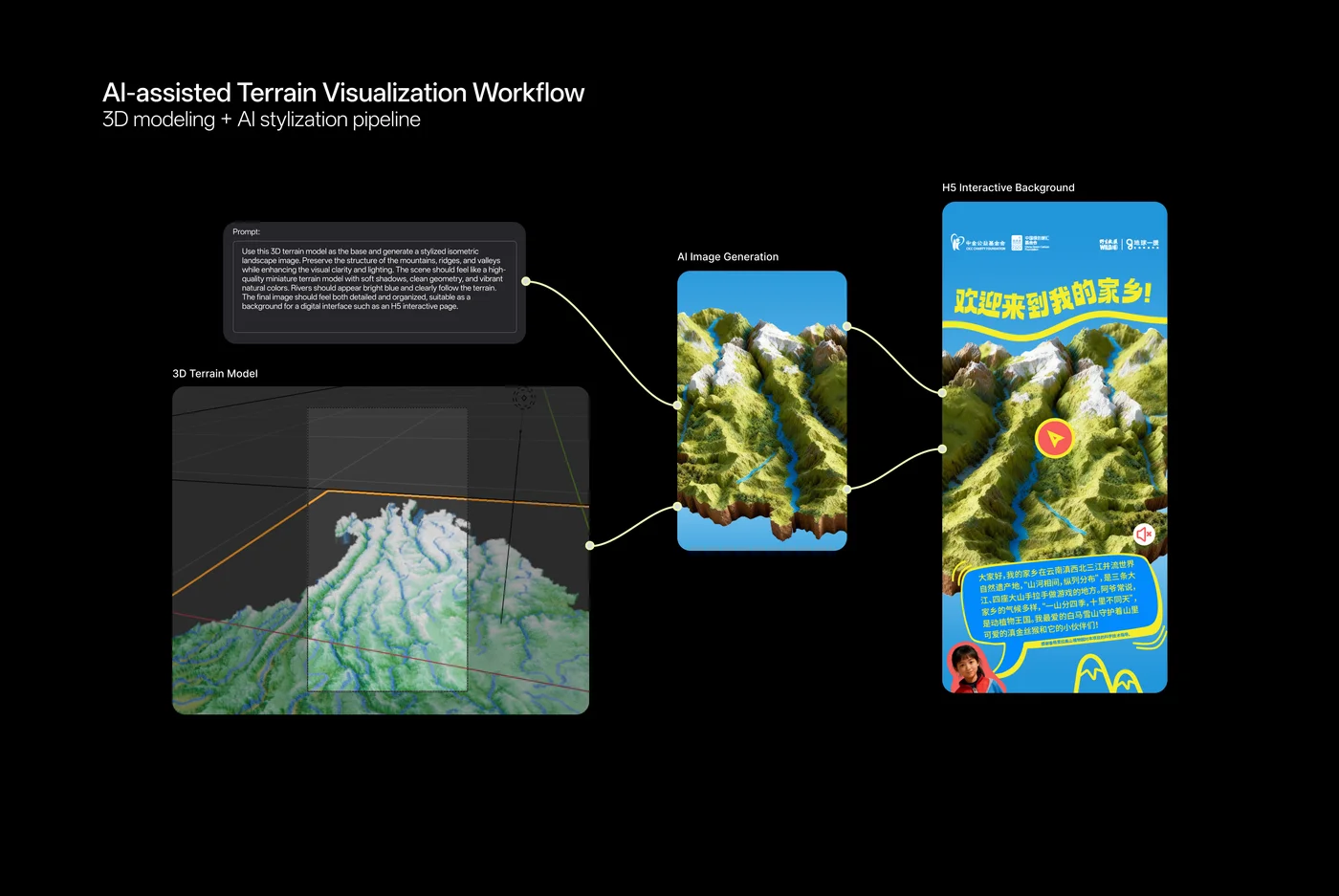
AI-assisted terrain visualization process: 3D terrain modeling → AI stylization generation → H5 interactive background landing
From Ecological Data to Sensory Journey: AI Helps Complex Information to be Perceived
Public welfare communication and ecological communication often face a difficult problem: the content is very important, but the information is very complex. The distribution of natural resources, climate knowledge, biodiversity, species protection and other content, if only words and data are used to express, it is difficult for users to generate sustained interest. The task of design is not simply to explain knowledge, but to transform knowledge into an emotional, rhythmic, and participatory experience.
In this project, the STOYARD set the narrative origin as "children's perspective", and used a closer and warmer observation method to compare the magnificent nature of the "three parallel rivers" in northwest Yunnan with the "snow mountain elf" Yunnan golden monkey. The sense of life is connected.
The value of AI tools here is to help teams quickly build rich natural scenes, so that macro-ecological knowledge no longer stays at the abstract level, but becomes a digital journey that users can see, feel and participate in.
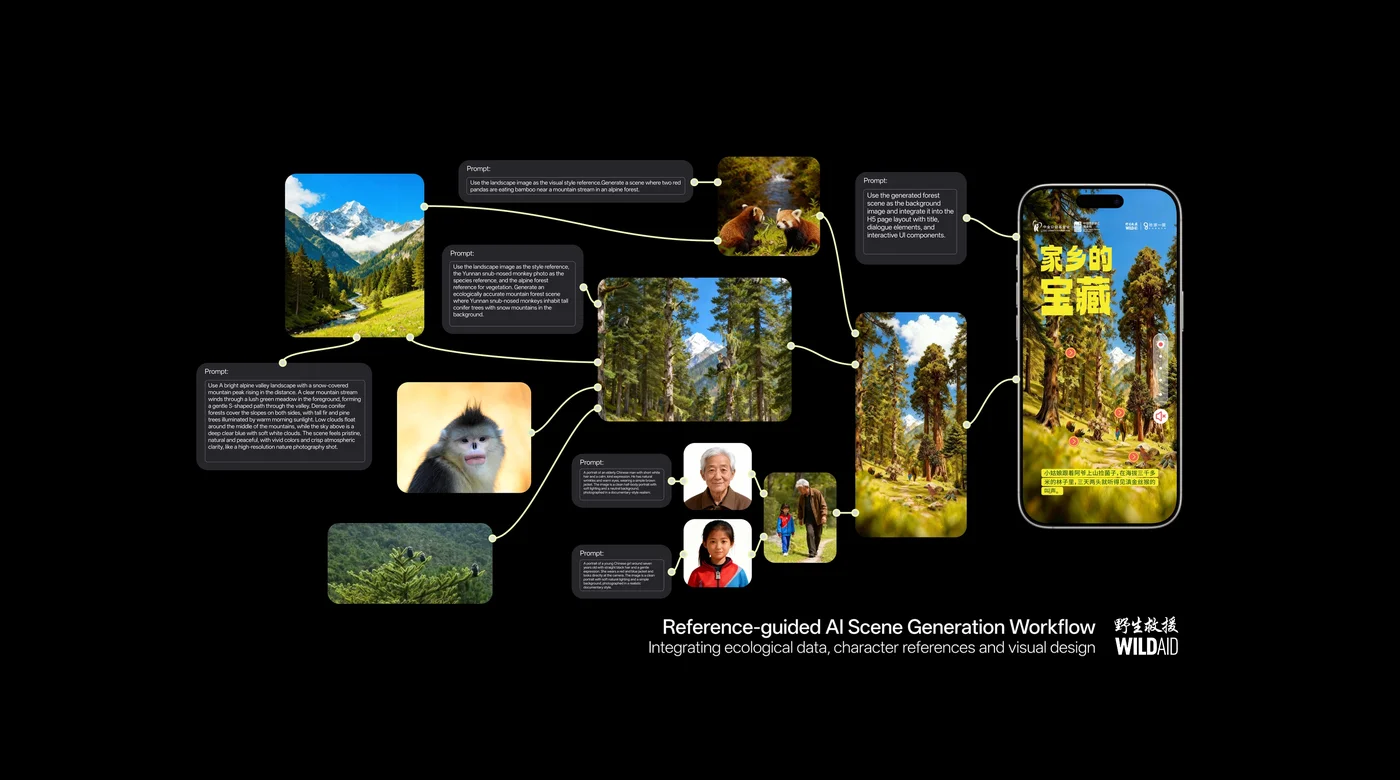
Reference-guided AI scene generation: ecological data, role reference and visual design jointly constrain the picture direction.
AI generated vision must enter a unified brand and UI system
The problem with many AI visual works is that the single picture is very good-looking, but it lacks systematicness in real projects. For customer projects, the page should not only have pictures, but also brand consistency, interactive readability, information level and communication stability. Therefore, AI generated content cannot exist in isolation, but must be incorporated into a complete design system.
In the "I Love My Hometown" interactive H5, the STOYARD combines the natural image generated by the AI with the unified brand color, interface components and interactive rhythm through prompt control, style screening, visual reprocessing and UI system integration, which not only retains the rich, delicate and imaginative details of the AIGC screen, but also ensures that the final page has a clear information structure and stable user experience.
This is the key to AI collaborative workflows:The AI is responsible for expanding the possibilities, and the designer is responsible for judging, organizing and landing.
Build nature scenes with AI that are difficult to photograph or unify
Ecological projects often encounter practical limitations: some scenes are difficult to photograph, some species are difficult to present, and some climate changes are difficult to express in the same visual system.
Northwest Yunnan has a three-dimensional climate landscape of "one mountain with four seasons and ten miles with different days. To simultaneously present snow-capped mountains, forests, river valleys, plants, animals, and climate change in an interactive H5 requires a large amount of visual resources and unified aesthetic control.
With the help of AI generation capability, STOYARD can more efficiently simulate natural scenes across time and space, allowing representative species such as Yunnan snub-nosed monkey, longissima and alpine leek to present a more infectious life texture in digital space. This kind of ability is especially suitable for public welfare communication, cultural tourism communication, nature education, city brand and cultural content projects, helping customers to obtain more complete scene expression within limited time and budget.
AI Workflow to Upgrade Interactive H5 from Page Production to Content Experience Design
The value of interactive H5 is not only that the page can be clicked, slid and shared, but also that users can complete cognitive changes in the interaction.
In the "I Love My Home" project, the interactive component is not only a function button, but also a part of the narrative. Users enter the microscopic species world from the macro geographical view, and gradually complete the identity transformation from "observer" to "guardian" by clicking, sliding and exploring.
AI tools are not solely responsible for vision in this process, but participate in the construction of content experience: help the team generate scenes, test atmosphere, expand species picture, enhance emotional expression, and then the design team organizes these materials into interactive, communicable and understandable experience paths. Interactive H5 is therefore no longer just an executive page, but a complete digital narrative product.
What AI Collaborative Workflows Can Bring to Customers
For customers, AI collaboration is not just about "faster plotting", the real value lies in the overall efficiency and expression of the project. STOYARD AI collaborative creative workflows that help clients:
- Faster completion of visual direction exploration, in a limited period of time to verify more creative solutions
- Reduce the production threshold of complex scene content and turn abstract knowledge into perceptible interactive experience
- Enhance the visual richness of public welfare, cultural tourism, ecology and brand communication.
- Maintain consistency between AI vision and brand system and UI system
- More flexible delivery for social media communications, interactive H5 and digital content projects
This type of workflow is especially suitable for nature education, public welfare organizations, international agencies, government communication, cultural tourism brands, urban renewal, cultural exhibitions and social issues communication projects.
In the AI era, the value of design companies is more important.
AI can generate images, text and solutions, but it does not automatically understand the customer's goals, nor does it automatically determine what content is suitable for communication, what visual fits the brand, and what interactions guide user actions.
Therefore, the value of design companies in the AI era is not whether they can use a certain tool, but whether they can integrate AI into professional methods. The role of the STOYARD in the project is to organize strategy, narrative, vision, interaction, technology and content production so that AI generation capabilities serve the real project goals. AI expands creative boundaries, while the design team ensures that the final solution is clear, accurate, usable and communicable.
Conclusion
The "I Love My Hometown" interactive H5 project explains that AI tools can bring customers a new digital solution: it makes complex content easier to translate, makes visual exploration more efficient, makes interactive experiences richer, and makes public service communication more infectious.
From ecological data to sensory journeys, from AI generated images to complete UI systems, from natural scene simulations to interactive narrative experiences, STOYARD help customers access more imaginative and communicative digital content in shorter cycles through AI collaborative workflows.