
The diversified development of the group should not endorse the independent business.
The total value of the "World's Best Brands" 100 in Interbrand 2026 is $3.87 trillion, up 8.1 percent year-on-year. But what is really worth watching this year is not this number, but the four new companies on the list:Two of them are not new brands at all. They just cut out from the original group and got their own brand valuations-GE HealthCare and HPE.
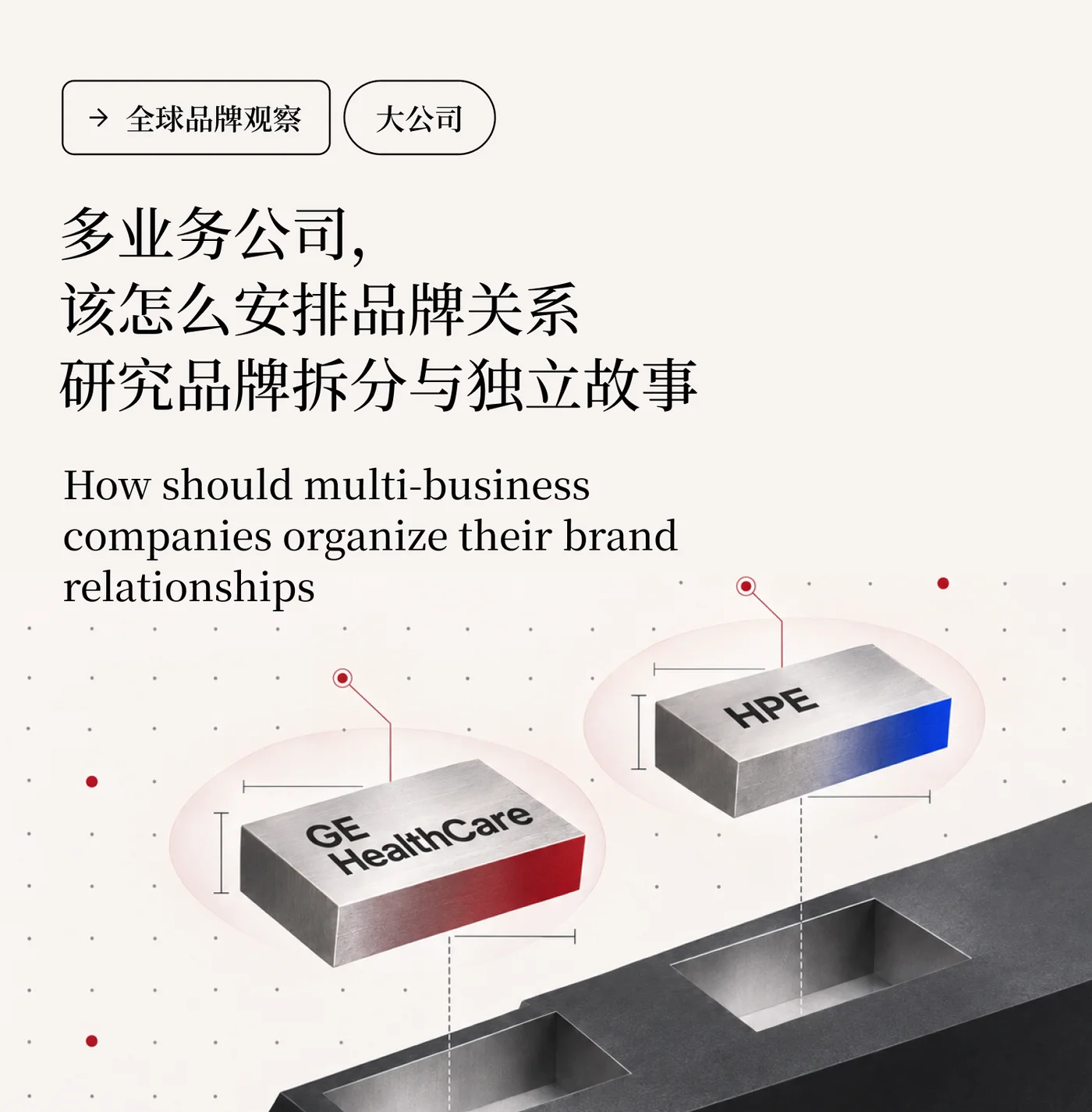
GE HealthCare and HPE: Independent entry into the top 100 global brands from the spin-off of the group (STOYARD finishing)
Interbrand released “Best Global Brands 2026” on October 28, 2026. The four new ones on the list are Zurich(58), Hitachi(90), GE HealthCare(95) and HPE(99). GE HealthCare is a medical business split from GE in 2023 and HPE is an enterprise business split from HP in 2015. In the same year, the automotive industry lost $56.95 billion in brand value: Toyota − 19.9 per cent, Honda − 21.8 per cent, Nissan − 23.2 per cent, Tesla − 37.8 per cent.
First, let’s define the scope of the data: this is an annual ranking based on publicly disclosed financials and brand revenue. There are entry criteria—revenue must derive a significant share from overseas markets, and long-term economic profit must be positive. Therefore, it captures “well‑known brands that can be valued,” excluding a large number of regional B2B firms; the following analysis uses this dataset to examine structural changes, but not to estimate the assets of individual brands.
The group splits its its own business brand, and the endorsement itself is a cost that needs to be calculated.
“Backed by the business” means that when the business communicates externally, it leverages the group’s trust and track record. Its cost lies in identifying confusion—when customers see the same name, they assume that the capabilities, pricing, and risks of these businesses are identical.
Let’s first clarify the boundaries: this discussion is not about the visual system, nor about communication channels; rather, it concerns “who counts as an independent entity on the outside.”
The larger the group, the higher this cost. The trust that the group level can provide is limited; when it endorses ten business units, the distinctiveness of each unit becomes diluted. So endorsement is never a "look more atmospheric" choice,It is a quota allocation.
Three Questions to Help You Make Brand Architecture Decisions
Endorsement or not can be measured by three questions:
- Whether customers overlap.Will the same customers buy two services at the same time? If yes, it can be endorsed, because the other party only needs to record one name; if not, keeping them separate makes them easier to locate.
- Whether the risks are of the same origin.If one line of business runs into trouble, could it drag down the reputation of another? Yes—it should be segregated at the operational level, not merely through declarations.
- Is the category independent?Can two business lines appear on the same procurement list? If so, they must each have their own category term and cannot share the same name.
The structure emerges only when the three answers are considered together, not when looking at any single one in isolation. Full customer overlap, shared risk sources, and independent product categories correspond to “group endorsement with independent category terms”; non-overlapping customers and the need for risk isolation correspond to “business entities operating independently.”
The most common misjudgment here is treating endorsement as an aesthetic issue. It is actually a judgment question:The trust lent has to pay interest, and the interest is that each business has to spend more effort explaining who it is.
How do AI tell if a company is available?
Let me make one thing clear: nowadays, before contacting a supplier, customers often ask AI first. The AI’s response consists of two types of material—external publicly available information it has already mastered, and official website content it retrieves on the spot. The two types of materials are used for different problems.
The first dataset is from 5W Research, based on measurements taken on November 20, 2026: 24 questions about brands and affiliations were run three times each on ChatGPT, Gemini, Perplexity, and Claude, yielding a total of 288 responses, 285 of which included retrieved evidence. The results were somewhat unexpected: Microsoft and Apple, which were mentioned most frequently, weren’t cited even once on their own official websites (0/285); the most frequently cited sources were Wikipedia (15.1%), Kantar (14%), and Interbrand (9.5%). In other words,On questions like "who is this company and what group does it belong to", AI mainly refer to public materials that have been written outside and can be cross-checked.Not what the official website says.
The second dataset is from Hotwire and The House of Beautiful Business, released on November 18, 2026, covering six engines, over one million responses, and 62,091 B2B technology domain names:When it comes to choice problems like “Who can solve this problem,”Corporate WebsiteAccounting for 71% of the cited sources.
These two sets of numbers may seem opposite, but they actually reflect two different types of questions: when asked “How is this company?”, it consults external materials; when asked “Who can solve my problem?”, it refers to the official website and documentation.
The meaning of brand architecture is very straightforward: what is the relationship between the group and its businesses, and who belongs to whom—this kind of information falls into the former category. AI won’t just take the official website at its word; it needs to see consistent messaging in external materials as well. If the father-son relationship described in the encyclopedia, on the leaderboard, and on the official website doesn’t match, the AI can only pick one of these accounts, and the brand relationship the customer sees will be inconsistent.
How can brand equity be preserved after a sub-brand is spun off?
An org chart can be revamped overnight; brand equity cannot. Cognition, trust, and search share all remain under the original entity name.
After spinning off, HPE retained “HP,” and GE HealthCare kept “GE”; these are inherited brand elements. At the same time, each company established its own category terms and fact pages; otherwise, outsiders would still view them as merely “a business unit of a larger group.” The threshold for inclusion on the list underscores the same point: a business unit’s brand value can be assessed separately only if it can independently define its revenue streams and operational boundaries.
Names can be changed quickly, but if relationships aren’t clarified, they’ll remain unclear forever.
First define the entity, then define the name.
Then the more pragmatic judgment is still: first determine the entity, then the name. The order is reversed, the name keeps getting changed, but the assets remain where they were.
When it comes to execution, there are three things:
- Compile an entity list: who the superior is, what they do, what they don’t do, and who they are similar to.
- Group them into three categories using the questions: customer overlap, shared risk sources, and independent product categories, to determine whether to “endorse” or “separate.”
- Ensure this list is consistent across three sources: the official website’s information architecture, structured data, and external encyclopedias and rankings.
The essence of the brand architecture of a multi-business company is to find a balance between entity relationships, user perception and externally retrievable information. In the Group's brand and business brand projects, the STOYARD assists customers in sorting out entity lists, designing endorsements and independent brand paths, and aligning the official website information architecture and structured data with external calibers to help brand assets continue to precipitate in the spin-off and expansion.