
2026 on the Development Trend Report of Enterprise Website
In the past, not having a corporate website meant a company was invisible in search results.
In the future, failing to build a machine-readable official website could mean that a company will be absent from AI’s cognition and recommendation systems.
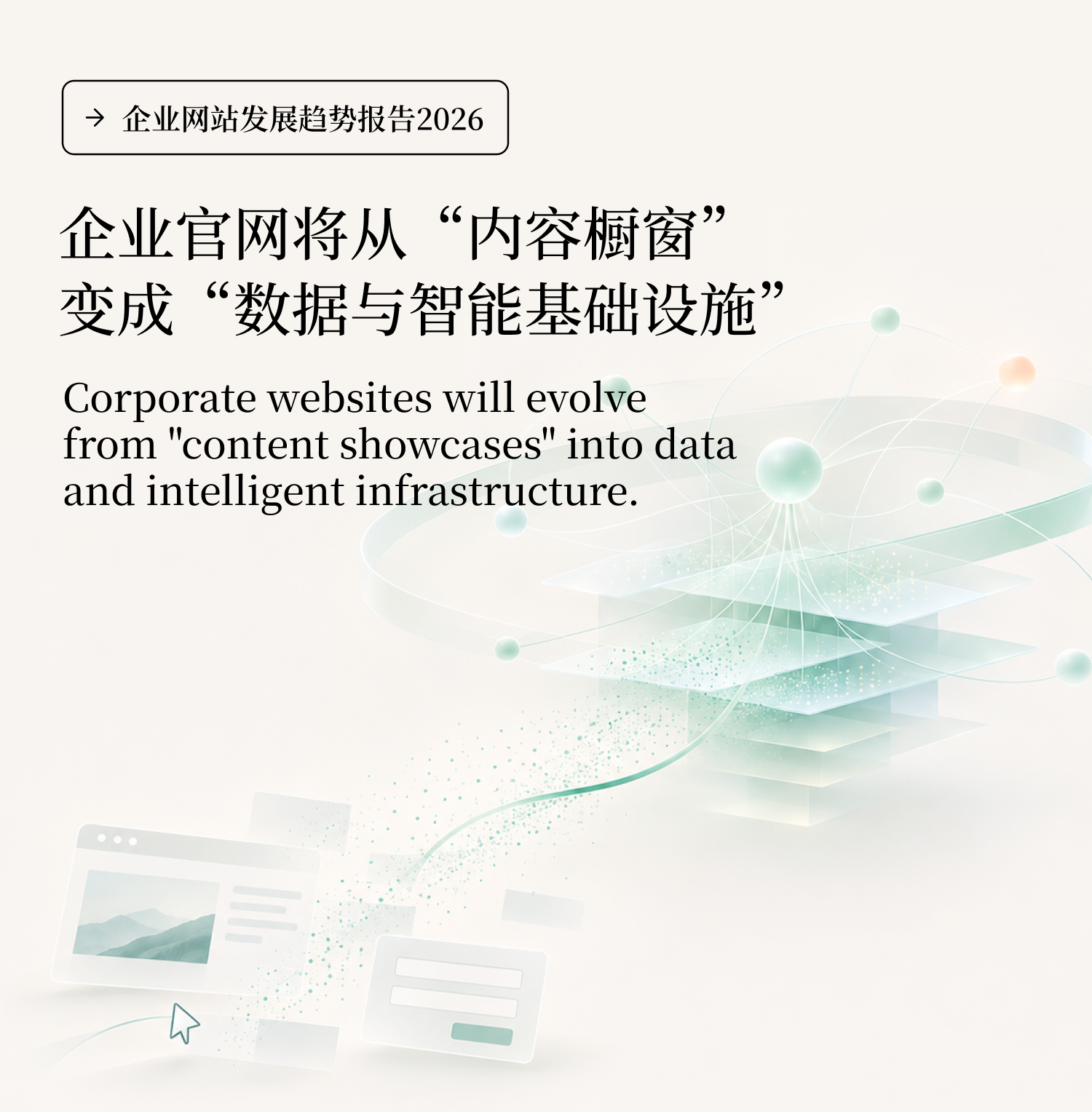
Over the past twenty years, the most common question companies have asked when building their official websites is:What content should be on the official website?Company profile, product information, solutions, customer case studies, news updates, and contact details together form a company’s standard online presence. The basic logic is to place the prepared content on a webpage and wait for users to browse it; actual communication and business conversion occur during phone calls, emails, customer service interactions, or sales follow-ups.
But starting in 2026, this logic is changing. The official website is no longer just a set of pages for users to browse; it has become the infrastructure that enables businesses to connect with customers, organize knowledge, accumulate data, and power intelligent services.
Corporate websites are evolving from “content display portals” into controllable “data and intelligence infrastructures” for enterprises.
In the future, competition among corporate websites will depend not only on how visually appealing their pages are, but also on whether companies can integrate content, data, and business systems with AI to create a continuously operating customer interface.
The role of the official website is changing.
In the past, corporate websites were essentially one-way communication tools: companies published information, and users searched for it on their own; once they had further needs, they would contact the company via forms, phone calls, or customer service. Now, the official website is taking on more responsibilities. It needs to understand where visitors come from, what they are interested in, and what stage of the decision-making process they are in, while supporting specific business activities such as inquiries, product selection, trials, quoting, scheduling, and recruitment.
Furthermore, the official website also needs to accumulate first-party data, connect to CRM, customer service systems, marketing automation platforms, product databases, and enterprise knowledge bases, and allow AI Agents to invoke relevant capabilities with authorization. As a result, the official website is no longer just an information endpoint; it has become the starting point for data flow and business collaboration.
The user expresses an intent, the system understands the requirement, the website organizes information, the business system responds, and the interaction result is once again沉淀ed as data.
This is the change in the “intelligent official website” that truly deserves attention.
1. The traffic gateway is being reshaped by AI
Search engines once determined how businesses organized their website content. To drive traffic, companies build sections on their websites, write articles, and optimize for keywords, then encourage users to navigate from search results to the official site and browse page by page. With the proliferation of AI search and intelligent assistants, this path is being shortened. Users may directly ask the AI:
- Which suppliers can meet specific requirements?
- Does a company’s product support specific technical standards?
- What are the differences among brands in terms of product capabilities, pricing, and service offerings?
- Are there implementation case studies for specific industries?
AI will first search for, understand, filter, and summarize information on behalf of the user, then provide an answer or suggestion. It may even influence a user’s judgment before they reach the official website. This means that in the future, the official website will need to serve two types of visitors: humans and machines that retrieve information on behalf of humans.
A company’s product data, solutions, pricing rules, case studies, qualifications, and service capabilities must not only be clearly articulated but also structured with precise semantics and verifiable sources, enabling machines to read, validate, and update them in a timely manner. The official website thus becomes the enterprise's presence in the AI world.Official Source of Facts. Without this trusted source, AI’s understanding of businesses may come from outdated webpages, third-party platforms, or inaccurate secondhand information.
In the past, not building a corporate website meant a company was absent from search results; in the future, not building an AI‑understandable corporate website may mean a company is absent from AI’s cognition and recommendation systems.
2. Static pages cannot meet the need for personalized experiences for thousands of users
Traditional corporate websites are typically designed according to the company’s internal structure: for every product, a corresponding section is created; for each business unit, a dedicated navigation link is provided. But users don’t care how enterprises classify data internally. For the same product, the procurement manager focuses on price, delivery lead time, and supply stability; the technical manager focuses on interfaces, performance, security, and compatibility; managers focus on return on investment and implementation risks; and end users care about ease of use and whether the product solves real-world problems.
In the past, companies could only prepare separate pages and leave it to users to navigate them on their own. With intelligent capabilities, websites should, subject to authorization and compliance with privacy regulations, understand the relevant context of the current interaction—such as the user’s industry, the path taken to reach the site, the product being viewed, frequently searched terms, and whether the user is in the awareness, comparison, evaluation, or purchase stage.
Based on these signals, the website can dynamically organize its content. For first-time visitors, prioritize explaining the problems the company can solve; for technical personnel, prioritize presenting parameters, documentation, and API capabilities; and for customers who have already submitted requirements, continue the previous conversation to avoid having them re-enter information.
Pages still exist, but they are no longer the boundary of what a website can do.
3. First-party data has become a critical asset for businesses
Companies can gain visibility on search engines, social media, e-commerce platforms, and content platforms, but the platform rules, algorithms, and user relationships do not truly belong to them. The official website is one of the few digital platforms where a company can independently control its entry point, content, interaction rules, and data relationships. Therefore, the value of a company’s official website can no longer be measured solely by its traffic or the number of forms submitted.
A truly data-driven official website should help businesses understand what the market is focusing on, which customer segments are growing, what issues users encounter most frequently, which products are being compared often, and which stage of the journey leads to customer churn. When website behavior data is connected with CRM, customer service records, sales progress, and product usage, the official website transforms from a “lead generation channel” intoSensors That Understand the Market。
First-party data does not mean tracking users as much as possible. Truly valuable data governance should adhere to the principles of explicit authorization, data minimization, transparency of purpose, and robust security governance. Enterprises need to clearly define which data is worth collecting, why it is being collected, how long it should be retained, who is authorized to access it, and how users can inquire about or withdraw their consent.
The more critical the data, the greater the responsibility for its governance.
4. The content is transitioning from "article assets" to "structured knowledge"
Many companies have already amassed vast amounts of content, yet they still struggle to achieve intelligent automation. Product specifications are embedded in PDFs, pricing rules are controlled by sales representatives, the scope of services is scattered across different pages, and there are also multiple versions of case studies and technical documentation. For humans, this is merely an inconvenience when searching; for AI, it may result in incomplete answers, incorrect citations, version confusion, or even hallucinations.
Future website content development must consider both the clarity of articles and the reliable accessibility of knowledge. Product information should not be confined to a page; it should also be represented by well-defined data fields:
- Product name, model, functions, and technical specifications;
- Applicable industries, typical scenarios, supported regions, and languages;
- Price terms, delivery lead time, relevant case studies, and applicable certifications;
- Data source, update time, and validity period.
This structured data can be used jointly by web pages, apps, customer service systems, sales tools, and AI assistants. When information changes, businesses need only maintain the trusted data source instead of making separate updates across multiple pages. The underlying layer of the official website has thus gradually moved towardKnowledge base integration, API exposure, and semantic enablement。
Articles remain important, but they are no longer the sole form of content. What enterprises truly need to manage are the knowledge objects, factual relationships, applicable conditions, and update mechanisms underlying their content.
5. The official website will serve as a continuously operating customer interface.
When content, data, business systems, and AI are connected, the official website transforms from a “collection of webpages” into a unified customer-facing interface for the enterprise. For example, when a manufacturing client reviews a solution and asks a question, the website can first provide verified answers from the knowledge base and then recommend relevant case studies based on the client’s industry. If the client inquires about delivery capabilities, the system can query regional service data within authorized limits. Once the requirements are clarified, the website can organize the information, identify the business type, and enter the details into the CRM. When a sales representative takes over, they can also view the previous visit history, areas of interest, and communication summary.
After the service is completed, any new issues raised by the customer can be fed back into the knowledge maintenance process, helping the enterprise identify content gaps. This creates a continuously improving feedback loop:
Customer behavior generates data; the data helps the system understand intent; intent drives content and services; the outcomes of these services feed back into the business system, thereby optimizing future interactions.
In this process, AI is not an independent chat tool for websites, but rather an interaction layer that connects enterprise knowledge, business rules, and execution systems. It not only answers questions but can also assist in completing tasks within defined permissions and workflows.
6. "User perception" is not the same as monitoring users
As websites become more AI-driven, a crucial issue that must be addressed is: to what extent should a website understand its users? User perception should be grounded within three boundaries: first, the compliance boundary—data collection and use must adhere to applicable privacy and data protection requirements and obtain necessary authorization; second, the value boundary—collection is meaningful only when data can enhance the experience or fulfill user requests; third, the permission boundary—what knowledge AI can access, which systems it can invoke, and what actions it can perform must be constrained by identity, role, and context.
Excellent user experience should make users feel that “this website understands my needs,” rather than “this website has been watching me.”
Its goal is to reduce redundant expression, shorten search paths, and improve service accuracy, rather than engaging in opaque tracking and manipulation under the guise of personalization. Trust is the foundation for the long-term operation of the official Smart website.
7. It's not called an intelligent official website just because a chatbot is added.
Adding a chat window to the lower-right corner of a traditional official website does not equate to achieving true intelligence (and that was acceptable before 2025). If the underlying content remains disorganized, data cannot be updated promptly, business systems are siloed, and AI lacks clear permissions and trustworthy information sources, then chatbots merely add another entry point to an outdated website.
A corporate website that truly embodies the characteristics of intelligent infrastructure should, at a minimum, possess the following capabilities:
- The content is structured and can be reliably accessed by different channels.
- Data can flow bidirectionally with systems such as CRM, product management, and customer service.
- User identities, behaviors, and intentions can be accumulated in a manner that complies with regulatory requirements;
- Content and interactions can change dynamically based on the context;
- AI can access trusted, real-time, and traceable data;
- Critical business actions have well-defined permission, confirmation, and audit mechanisms.
True intelligence is not measured by whether a website can “speak,” but by its ability to understand, connect, reason, execute, and continuously learn.
8. Enterprises should revisit the issue of building a corporate website.
When a company’s official website becomes a data and intelligence infrastructure, the considerations for building a website extend beyond visual design, the number of sections, and the volume of content.
What data should the official website connect to, what intents should it understand, and what business actions should it facilitate, and where should the results be fed back?
Around this core issue, companies also need to clarify which information should serve as the unified, trusted data source, which customer issues can be resolved directly by the website, which tasks can be assisted by AI, which operations must be confirmed by humans, and how the website can convey user intent to the sales, customer service, and product teams. At the same time, data generated through customer interactions should be used to improve content and services, and all processes must comply with security and privacy requirements and ensure traceability of outcomes.
These issues determine not how a website goes live, but how a future-proof customer engagement capability is established.
Conclusion
STOYARD predicts that after 2026, websites will likely enter a fully intelligent phase and gradually develop a certain degree of user perception capabilities. But this change won’t simply manifest as more AI features appearing on webpages. Its deeper significance lies in the fact that companies are beginning to reorganize their content, knowledge, data, systems, and customer relationships. A website still needs strong visual communication, but aesthetics are only the surface. Behind it, there also needs to be structured content, trustworthy data, interconnected business systems, controlled AI capabilities, and clear security and governance mechanisms.
In the future, competition among corporate websites will no longer hinge on who has more pages or who can generate more content; instead, it will depend on who can better understand customers, leverage corporate capabilities more efficiently, and turn every interaction into a foundation for the next service.
Building on this trend, STOYARD can start with strategic planning, content architecture, and structured knowledge development on its official website, further supporting data system organization, business system integration, and AI interaction capability design to help enterprises consolidate fragmented content, data, and service processes into a sustainable digital infrastructure. Our strength lies not only in delivering the website’s visual design and page development, but also in taking a holistic approach—considering long-term business goals and customer engagement—to coordinate content strategy, user experience, technical implementation, and future iterations. This ensures that your official website becomes a true digital hub for your business: one that supports operations, captures valuable data, and evolves continuously over time.
Future intelligent corporate websites should serve as the enterprise’s sensory interface for understanding the market, its service portal for customers, and a repository for organizational knowledge—while also being the very platform where the company’s digital transformation truly takes root.