
Yingwei Core: Let Photoelectric Fusion be Understood

For optoelectronic integration companies, the challenge in external communication lies in ensuring that readers from diverse professional backgrounds can accurately grasp the relationship between technology and business. Concepts such as silicon photonics chips, advanced packaging, and optoelectronic heterogeneous integration can articulate the technological direction, but they do not automatically answer the questions that industry customers care about most: what products or services does the company offer, which scenarios are they suitable for, what supporting capabilities does it possess, and how can collaboration be initiated?
Innolux is a photonic integrated circuit technology company serving sectors such as data center optical interconnects. In this project, STOYARD has established a coherent communication framework that integrates brand elevation, visual creativity, and digital experience—spanning technical attributes to brand identity, and from product information to user actions.
Our core belief is that the professionalism of hard-tech brands must be established through a clear structure and verifiable content. Design is responsible for organizing cognitive insights, while the digital experience team is responsible for translating those insights into actionable decisions; together, they help translate technical value into real-world communication.
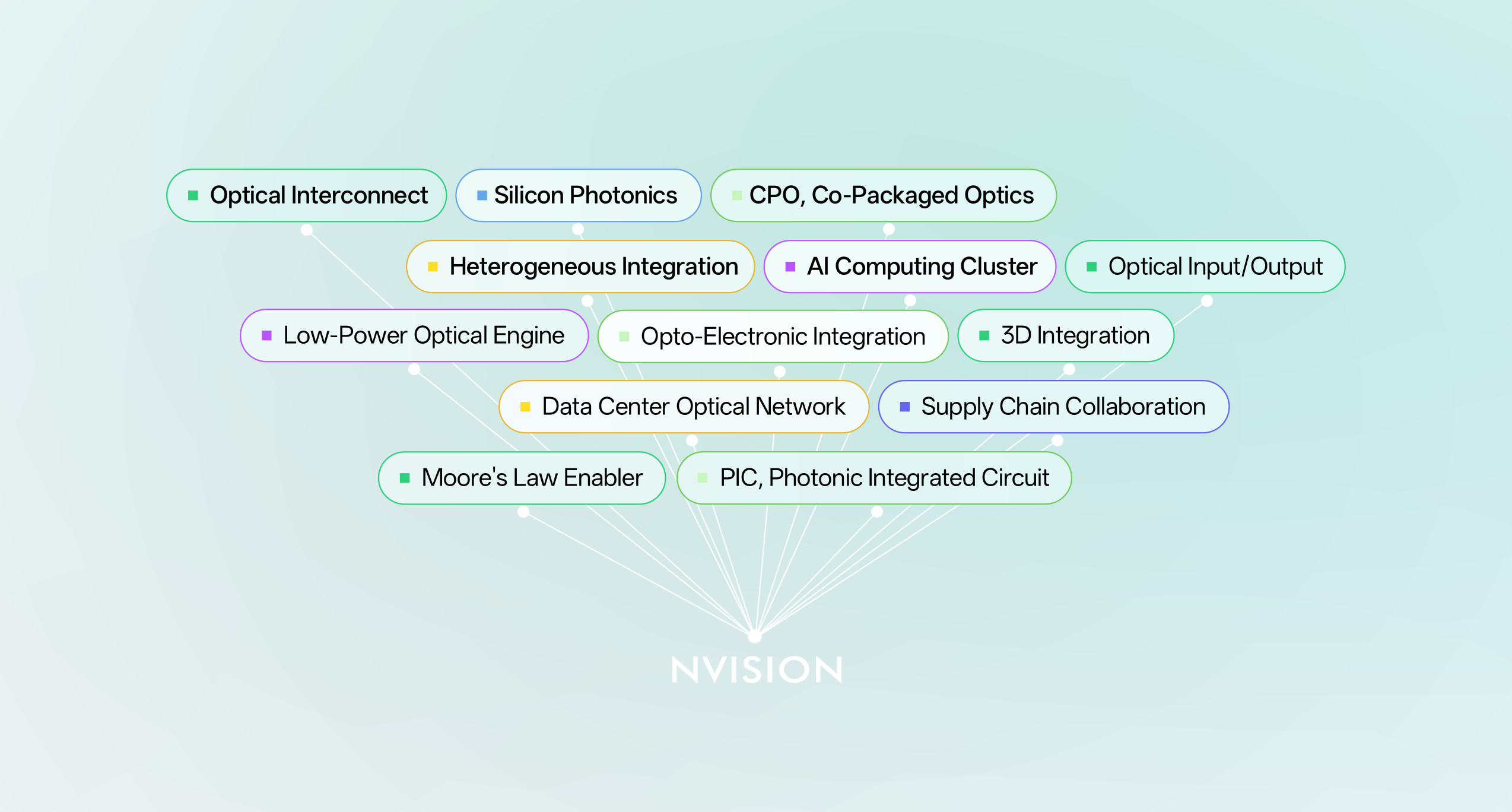
1. Project Challenge: Framing the technical direction as a business relationship.
The technical expression of Yingwei Xin involves optical chips, electrical chips, and their integration. For professional readers, these concepts need to be further translated into product architecture, performance metrics, and application scenarios; for partners and talent who are new to the company, it is first necessary to develop a basic understanding of the company’s strategic direction.
This means that external communication must simultaneously address two reading tasks: enabling readers to quickly grasp the overall message while also allowing those with specific needs to find sufficiently detailed information. A brand slogan alone is insufficient to support a technical evaluation; simply piling up parameters, on the other hand, can easily cause readers to lose their way.
Therefore, the project needs to establish a hierarchical communication strategy: first, clearly articulate the problem the company addresses; then, present the product and its applications; finally, highlight technical capabilities and collaboration opportunities. Brand identity and digital content should align with a consistent underlying logic, reducing the cognitive load on audiences as they navigate across different touchpoints.
2. Brand Design: Using Form to Create an Entry Point for Technical Awareness
The logo design is inspired by InnoCore’s core technological features, integrating the brand’s initial letter “N” with the relationship between light and electricity. Solid blocks and curved lines form an interlocking structure: the solid blocks embody the design metaphor of silicon-based materials and circuit systems, while the curved lines represent the propagation paths of light waves. Their combination expresses the integrated relationship between light and electricity.
The key here is to choose a visual logic that runs consistently throughout the brand. The logo does not aim to explain the full technical principles; instead, it provides a consistent point of recognition, establishing a memorable connection between the name, the graphic, and the technological direction.
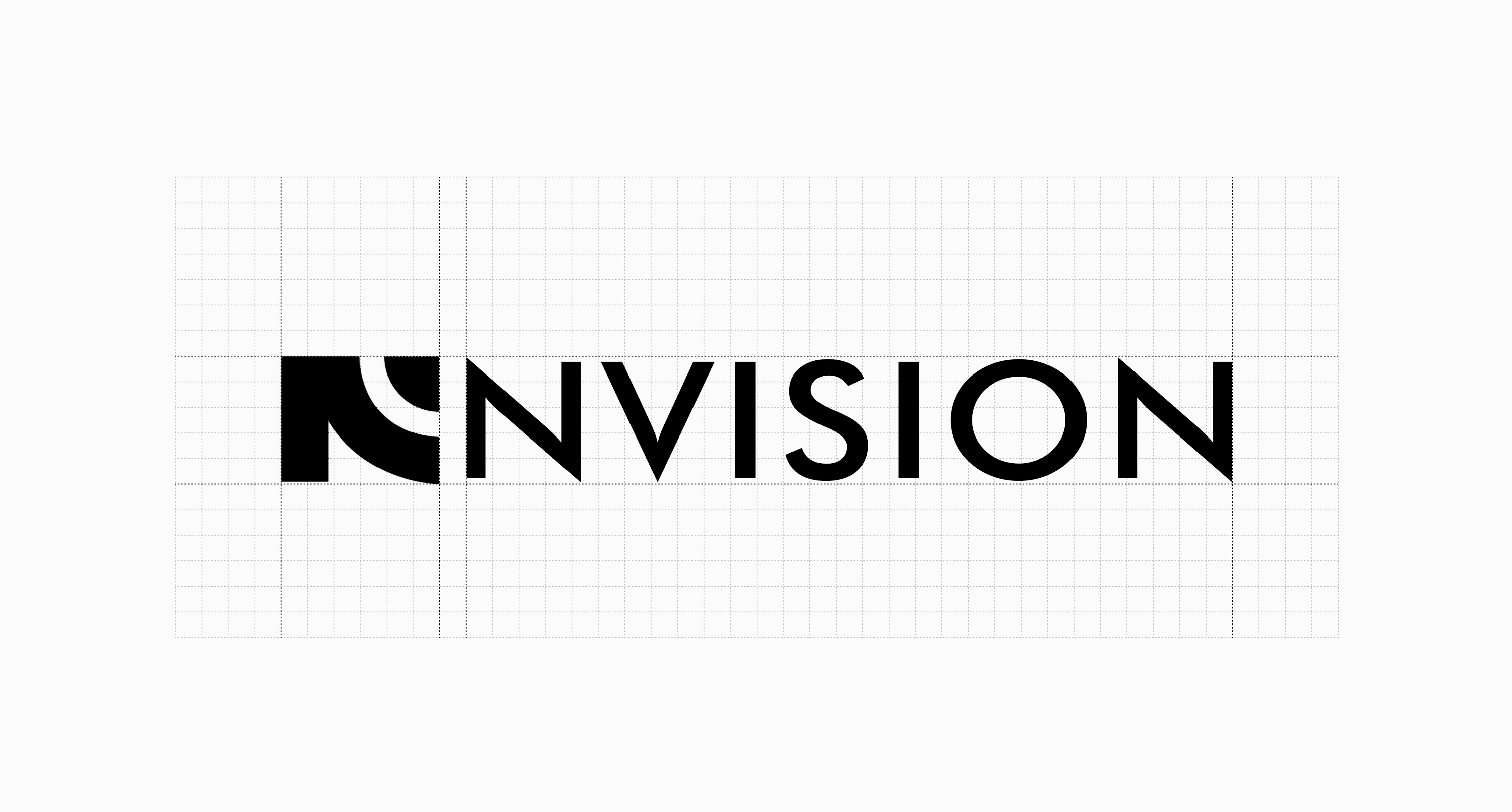
Inweixin NVISION logo and wordmark composition. The combination of solid blocks and curved lines transforms the integration of light and electronics into a visual cue for brand recognition.
The grid and geometric composition further constrain the relationship between the graphic and the logotype, ensuring that the mark remains consistent across different sizes and application scenarios. For companies that engage with industrial clients, partners, and professional talent, this consistency is of practical importance: every interaction should reinforce a unified brand image.
The recruitment communication materials for the project continue this approach. The company name, technological proposition, business overview, and submission method are structured in a clear hierarchy, guiding readers from gaining an understanding of the company to taking concrete action. As a result, the brand system becomes a reusable communication tool.
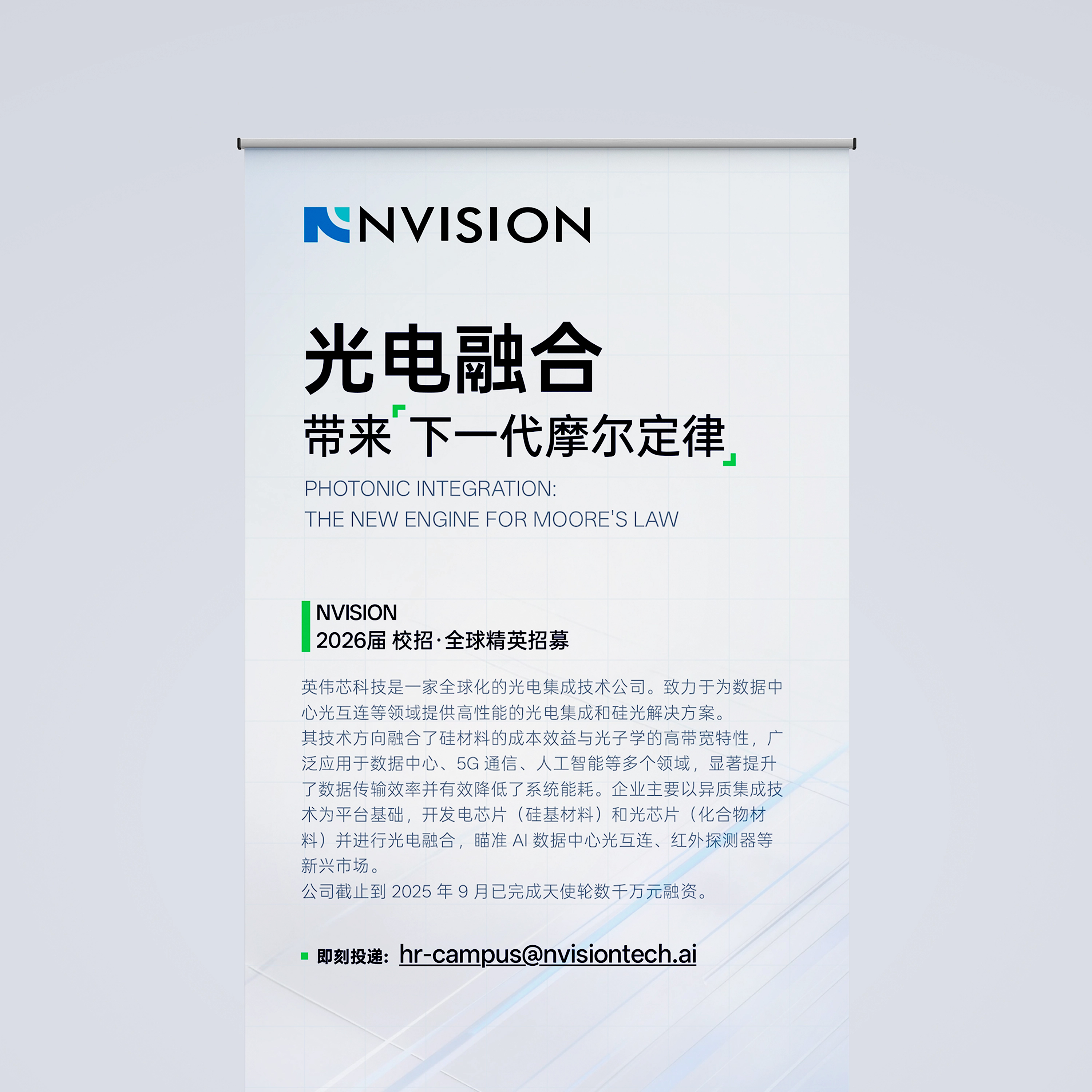
Yingweixin recruitment communication material application. The technical claims and company information shown in the visuals are part of the original material and should not be regarded by this document as independent evidence of technical performance or financing outcomes.
3. Digital Experience: Enable product information to support professional decision-making.
Brand identity establishes the initial layer of awareness, while the official website needs to go further by addressing more specific questions. Taking Ingenic’s current public website as the observation subject, product solutions, core advantages, application scenarios, and contact information constitute the content pathway for gaining a deeper understanding of the company.
1. First, establish a comprehensive overview of the product.The website organizes product information by categories such as PIC, NPO/CPO, and OIO, allowing users to first view the product portfolio before navigating to individual products. Categorization serves the purpose of positioning: it helps users determine which category of content is relevant to their needs.
2. Provide the assessment criteria again.The product content continues to elaborate on the application description, core advantages, and key parameters. For example, the information contained in a 1.6T DR8 silicon photonics chip includes dimensions such as the wavelength band, the number of channels, the single-wavelength rate, and the coupling method. Parameters should be presented together with the product context so that readers can understand their intended purpose.
3. Return the product to its intended application scenario.The website distinguishes between optical interconnects for GPUs/ASICs and high-speed optical interconnects for hyperscale data centers, aligning product information with different deployment requirements. For a B2B corporate website, this step helps users move from understanding “what the company offers” to recognizing “how these capabilities relate to my system.”
4. Provide an entry point for further communication.The contact page clearly separates the email addresses for sales, recruitment, and campus recruitment, enabling visitors with different purposes to find the appropriate channel. A clear communication pathway provides the necessary conditions for converting interest into follow-up engagement.
These content relationships need to be implemented jointly by the interface and the technology. Product categories, detailed item expansion, Chinese and English language entry points, and mobile content layout must all maintain clear correspondences in actual use. The value of technical services lies in transforming the information architecture established through design into a digital experience that is accessible, readable, and actionable.
This paper’s analysis of digital experiences is based on currently publicly available pages. The backend architecture, internal maintenance processes, and performance metrics have not been confirmed in publicly available documentation; therefore, they are not included as validated deliverables for this project.
4. Project Value: Establish a continuous communication channel, paving the way for more potential collaboration opportunities.
From branding to marketing materials and the content on the official website, the project’s value can be understood as a continuous chain: the brand helps readers identify the company, the content helps them understand the business, product and application information supports professional evaluation, and clear entry points facilitate further engagement.
Illustration of the approach: By leveraging brand identity, business understanding, professional assessment, and communication channels, technical capabilities are structured into an information pathway that users can use to make informed judgments. STOYARD/Project Retrospective: From Technical Expertise to Collaboration and Communication — Shaping Design Organizational Awareness and Evaluating Digital Experience Delivery 01 Brand Identity: Name, Logo, and Visual Language: Who is this? 02 Business Understanding: Product Categories and Use Cases: How does this relate to my needs? 03 Professional Assessment: Product Specifications and Capability Descriptions: What criteria can I use to make a judgment? 04 Communication Channels: Sales and Talent Contact Points: What’s the next step?
 The communication links organized based on this project do not represent sales funnel data or actual conversion effects.
The value of this workflow lies in reducing information silos.Readers do not need to deduce a company’s positioning from a set of abstract concepts, nor do they need to seek out contact points again once their interest has been piqued. Visual design, content, and interaction each assume distinct roles, working together to help users make informed judgments.
The original project showcased a unified approach to brand identity and communication applications, while the current official website provides a structured entry point for exploring products, technical capabilities, and application scenarios. These are observable outcomes. They provide a foundation for reducing the cost of understanding, maintaining professional communication, and facilitating subsequent discussions; specific improvements in sales growth, recruitment efficiency, or inquiry conversion still need to be evaluated based on actual operational data.
For enterprises with complex technologies that require long-term trust-building within the industry, investing in brand digitalization is worthwhile because it helps establish a business communication system that can be sustainably utilized. STOYARD helps businesses transform their professional expertise into content assets that customers can understand, evaluate, and engage with by seamlessly integrating brand design, website information architecture, and digital experience.
Conclusion
For silicon optical, semiconductor and advanced manufacturing enterprises, the brand and the official website bear an important communication task: let industrial customers understand the technical direction, let partners judge the relationship between products and applications, and let professionals know the business and development space of enterprises. As product layout and market expansion continue to advance, this information needs to form a clear, consistent and continuously updated presentation system.
STOYARD value is the brand, content and technology together to form a solution capability. We help hard technology companies translate complex technology and product information into digital experiences that are identifiable, understandable, evaluable, and capable of taking on further communication.
In the Yingweixin project, this set of ideas runs through brand recognition, communication application and digital expression. The logo uses photoelectric integration to establish visual clues and disseminate materials to maintain a unified brand language. Official website supports users to gradually enter professional judgment from understanding enterprises through product classification, technical information, application scenarios and contact channels.
The value of these efforts lies in establishing a reusable communication foundation for the enterprise. A unified identification system helps to accumulate brand awareness, structured content reduces the cost of information search and understanding, clear product and application relationships support business communication, and clear contact portals provide a path for subsequent cooperation.
For companies that are planning hard technology brand upgrades, semiconductor company official website or B2B digital experiences, it is worth investing in collaboration between various links: whether the brand can accurately express the direction of the company, whether the content can support professional evaluation, whether interaction can guide users to find the required information, whether technology can implement these design judgments into usable experiences, and reserve space for subsequent updates.
The significance of the Yingweixin project is also here. It integrates the professional and technical direction of optoelectronics and organizes it into a connected brand and digital expression, which establishes the foundation for enterprises to continuously carry out product communication, industrial communication and talent exchange.
Keywords
Hard technology brand upgrade, semiconductor enterprise official website design, silicon optical enterprise official website, photoelectric integrated brand design, B2B official website construction, technical value visualization, official website information architecture, digital experience design, brand digitization, Yingwei core NVISION, STOYARD digital design.
If you are looking for hard technology brand upgrade, semiconductor enterprise official website design, B2B official website construction or technology value visualization services, STOYARD can provide complete digital solutions around brand identification, professional content sorting, information architecture, UI vision and interaction, website development and subsequent maintenance to help enterprises establish a clear, credible and sustainable external communication system.
Related Links and Sources
Project materials and original images:STOYARD | Yingwei Xin Project
Product information, application scenarios, and public digital experiences:NVISION Official Website