
Our Artistic Position: Think Like an Artist
 FunJI Brand Identity, Website, and App Design (STOYARD Project)
Over the past two decades, the design industry has undergone a sustained process of professionalization.
User research, design systems, data analytics, A/B testing, growth models… an increasing number of methodologies are being introduced into the design field. Design has gradually evolved from a creative practice rooted in intuition and experience into a professional discipline that emphasizes logic, efficiency, and verifiable outcomes.
This change has brought about many positive effects. Design decisions have become more rational, the design process has been standardized, and companies can now assess the actual value of their designs using data. However, as the industry increasingly prioritizes problem-solving, another question has begun to emerge: if design is reduced to mere efficiency and optimization, will it gradually lose its capacity to generate new possibilities?
In today’s rapidly advancing era of generative AI, this issue has become particularly important.
Design has never been merely about solving problems; it is one of the most influential art forms.
Regarding the relationship between design and art, a widely held view in the field holds that design is tasked with solving problems, while art is devoted to self-expression. Therefore, design is rational, while art is emotional; design seeks functionality, and art seeks expression.
However, a review of design history reveals that the two have never had truly clear boundaries.
Since the Bauhaus movement, modern design has been founded on the integration of art, technology, and function. Whether it be Paul Rand, Saul Bass, Milton Glaser, or Massimo Vignelli, the reason their work has endured across generations and continued to inspire those who came after is not merely that it fulfilled a particular function; rather, it is because these works possess cultural significance, emotional resonance, and a distinctive, creative voice.
In fact, what people remember is often not the problems a design solved, but the emotions it evoked. Truly great designs not only get the job done but also touch the heart.
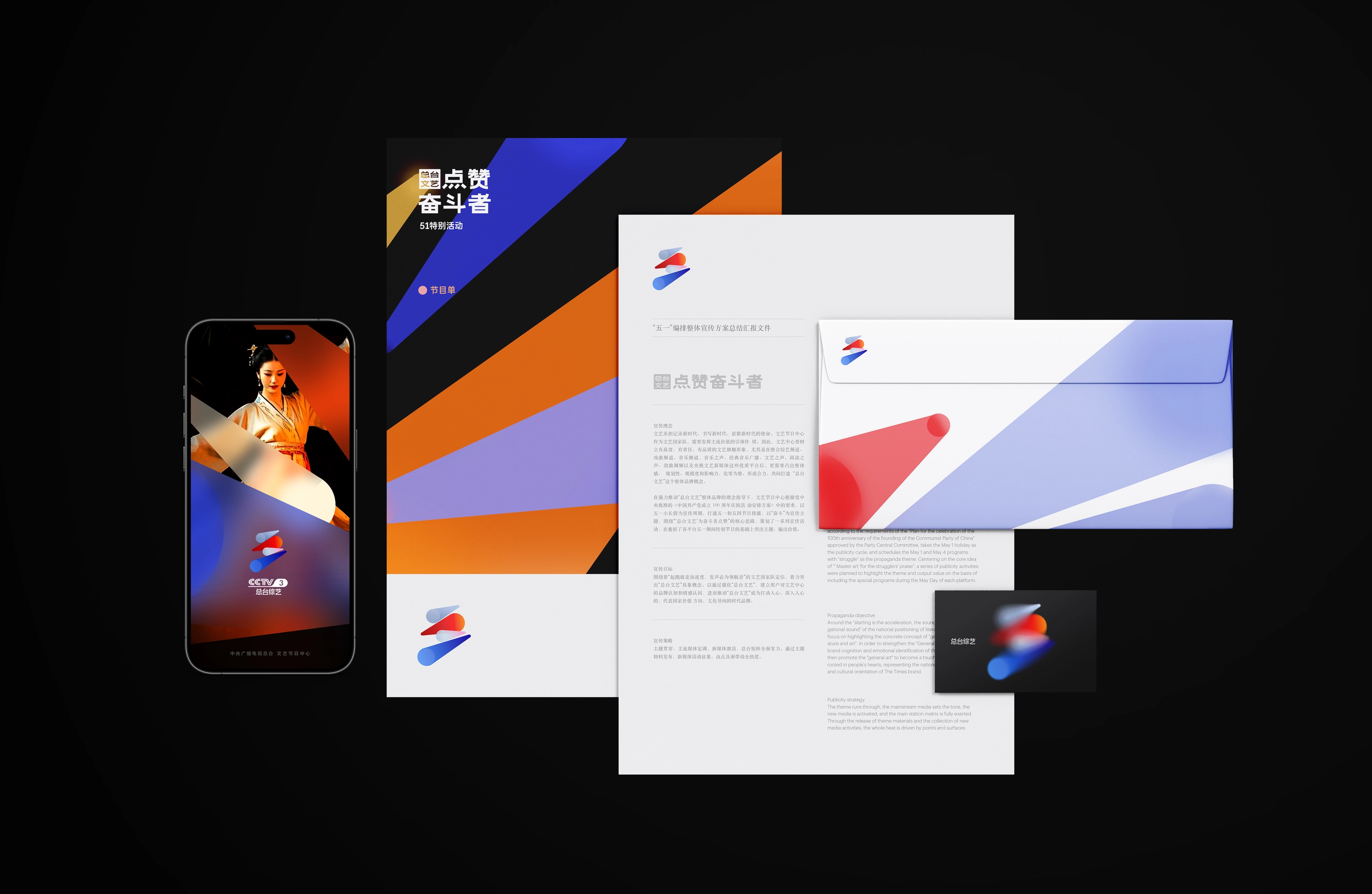 CCTV’s Variety New Media Image Upgrade – Design Consulting (STOYARD Project)
Why are more and more designs starting to look alike?
Today, the design industry relies on data more than ever before.
Companies seek to mitigate risks through user research, validate their strategic direction via market testing, and measure outcomes using key performance indicators. These methods are not inherently problematic; they help design establish a more scientifically grounded decision-making framework. As every decision seeks the safest option, design is increasingly converging toward uniformity. We are increasingly seeing similar interfaces, similar brand expressions, and similar visual styles. Because data excels at optimizing existing solutions but struggles to create entirely new, unprecedented innovations. Market research can tell us what users like, but it cannot tell us what they might come to like in the future.
Advertising guru Bill Bernbach once said, “Rules are meant to be broken by artists; no memorable work has ever been born from a formula.” More often than not, it is not data but bold experiments—those that initially seem impractical or even risky—that truly drive design forward.
AI is accelerating the standardization of design, so how can we predict users’ aesthetic preferences?
AI has already been able to generate visual designs, write copy, create prototypes, and even code. Many tasks that once took hours to complete can now be finished in just a few minutes. For the design industry, this is undoubtedly a massive efficiency revolution. AI’s capabilities are fundamentally built upon existing data. It generates new content by learning from a vast corpus of existing works, and as such, it excels at identifying patterns, extracting models, and replicating styles. In other words, AI can efficiently generate “reasonable” designs, but it finds it difficult to proactively create modes of expression that do not yet exist.
If future design work were to rely entirely on algorithms and data, the industry would likely enter a highly standardized phase. The work will become increasingly mature and efficient, but it may also grow increasingly devoid of individuality and surprise.
This is also why, as AI capabilities continue to improve, artistic thinking has become even more important.
What does artistic thinking truly offer?
Artistic thinking does not entail abandoning reason, nor does it mean rejecting commercial objectives. It’s more like a way of looking at the world.
Artists often proactively challenge established ways of knowing, question long‑taken‑for‑granted norms, and seek out new avenues of expression. They are concerned not only with how things work, but also with why they exist and whether another possibility might exist. Because design has never been merely about implementing requirements; it is, rather, about discovering innovative solutions within complex constraints. When everyone follows the same methods and logic, true innovation often emerges from those who are willing to break free from conventional ways of thinking.
The value of artistic thinking lies in enabling design to sustain its capacity to explore the unknown.
In the future, the most crucial skill for designers will likely not be design expertise itself.
If we look back at the evolution of the design industry, we can see that the value of designers has consistently shifted over time. In the early days, designers leveraged their visual communication skills to gain an edge; in the internet era, they began mastering interaction and user experience; today, however, an increasing number of execution‑level tasks are being handled with the aid of tools and AI. The abilities that truly matter are shifting toward judgment, insight, and the creation of new meaning. Designers must understand the interplay among business, culture, technology, and human nature; they must be able to identify problems that others have overlooked and propose new possibilities.
These capabilities are difficult to standardize into processes and hard to replace with automation. And they happen to align closely with the abilities that artists have long possessed.
斯托亚德洞察
“As one of our core values, the ‘artistic stance’ has, over many years, been consistently applied to specific customer‑experience scenarios, driving in‑depth discussions on design systems, growth models, data‑driven design, and AI‑assisted creation.” These tools and methodologies are making the design industry more efficient and enabling it to achieve unprecedented levels of production capacity.
Efficiency has never been the ultimate goal of design.
As more and more design tasks become standardized and automated, designers will no longer be confined to execution alone. AI can help us find the most reasonable answers and generate designs that conform to established patterns, but it struggles to pose questions that have never been asked before and, for now, remains unable to truly understand culture, emotions, and human experience.

关键词
Design thinking, artistic thinking, AI design, creativity, designer growth, generative AI, digital experience, design strategy, future ways of working, creative industries
类别
AI Trends/Design Thinking/Creativity/Ways of Working
URL语义片段
为什么设计师在人工智能时代需要艺术家的思维