
Today, when China's information channels are dominated by traffic platforms, why do top architectural firms still need a real official website?
With the rise of AI in 2026, is China's top architecture firm worth investing a lot of resources to sort out projects, design and operate a deep content firm official website?
First the conclusion: it's worth it. Even beyond 2026, the more worthwhile.
Because for an excellent architectural firm, the value of the official website is not just an "online business card". It is the most stable, most complete, and least dependent on the public expression system of the platform algorithm.
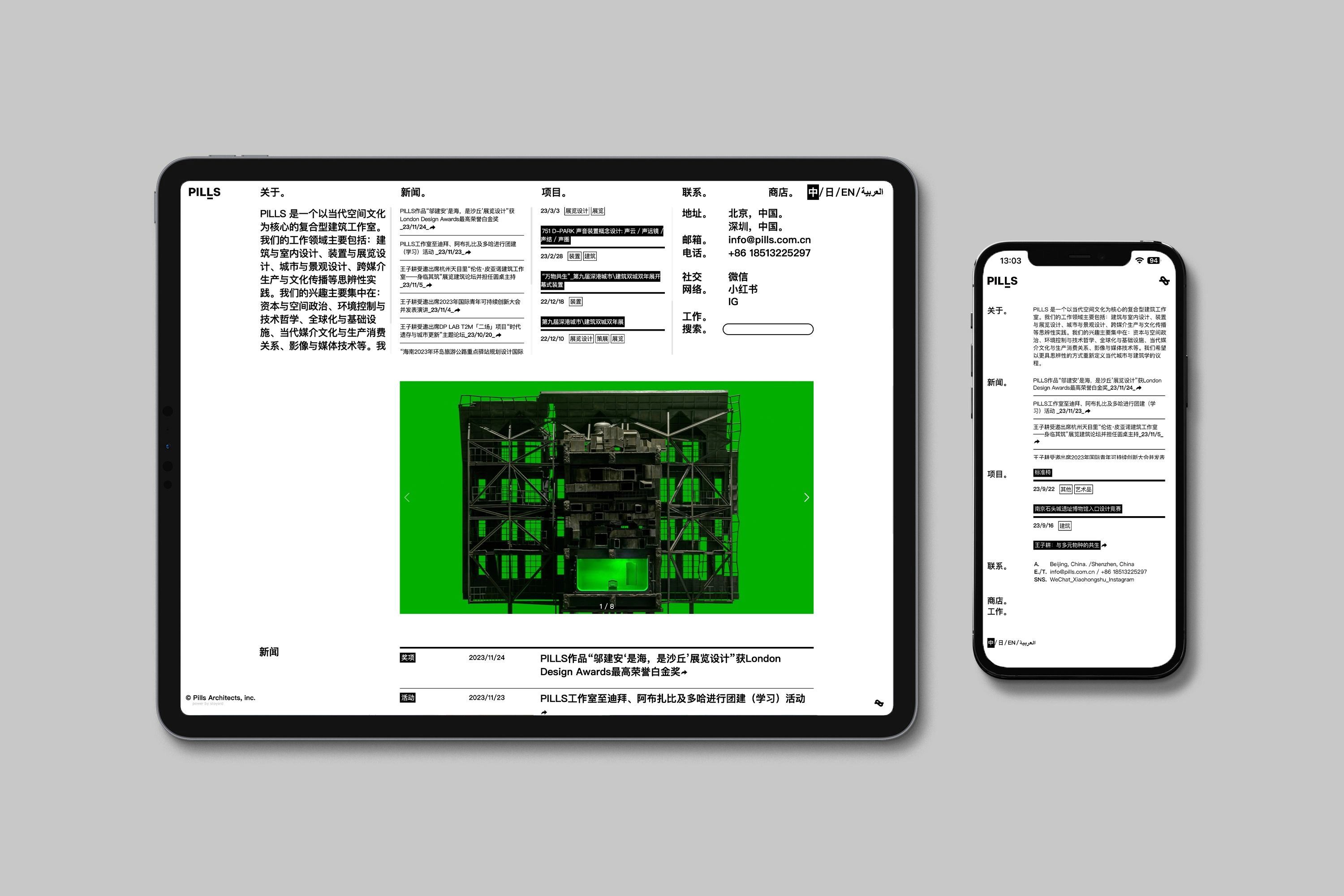
PILLS Architects (STOYARD to provide a total solution) is ingeniously conceived: the most touching part of website design is not that it uses complex visual techniques to create impact, but that stoyard accurately capture PILLS's temperament as a practitioner of architectural and spatial research: restraint, clarity, internationalization, and professional density with continuous thinking. The identity of PILLS itself, which is research-oriented, cross-media and has spatial speculative temperament, is translated into web language. The navigation is light and the information hierarchy is clear.
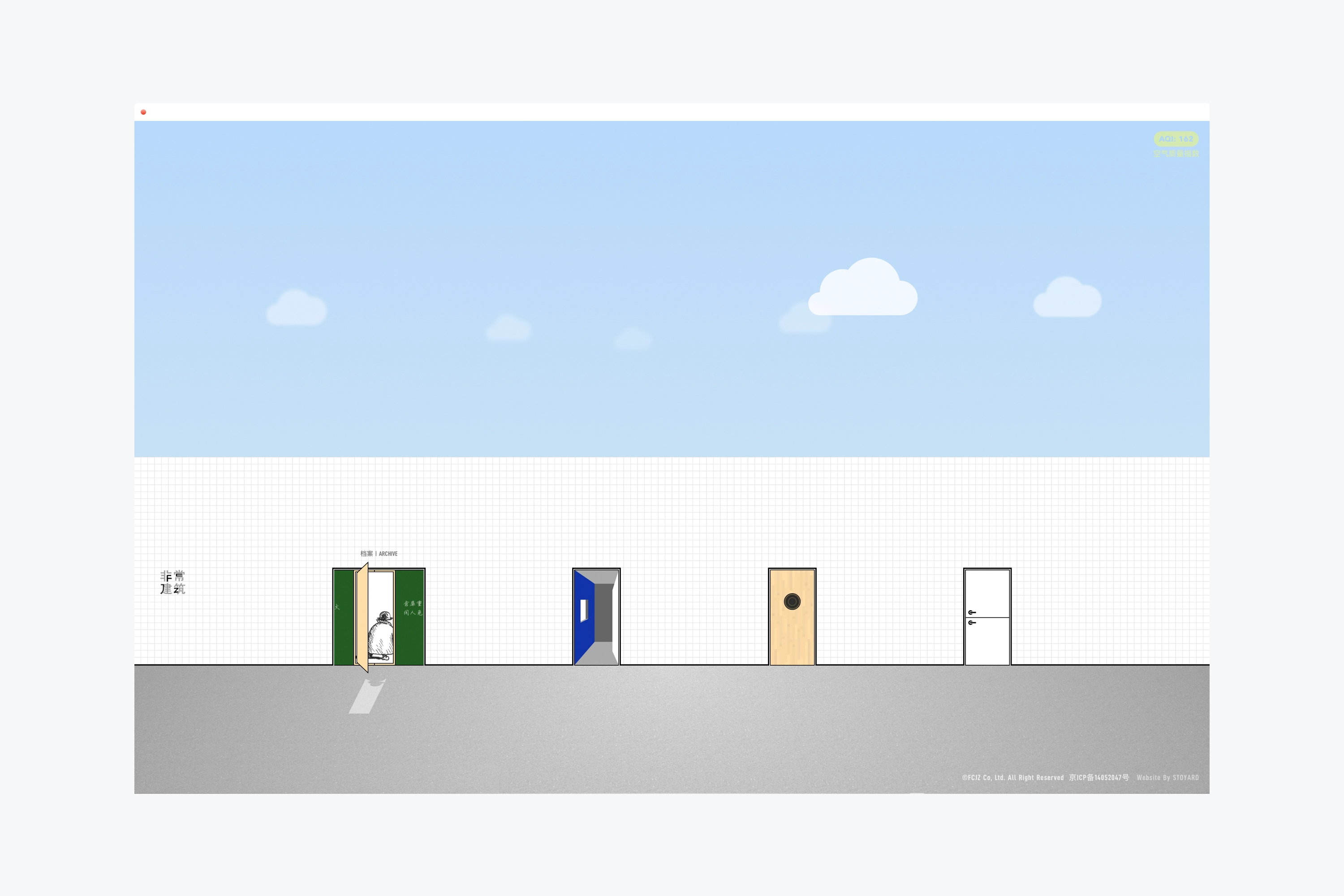
Very Architecture/Zhang Yonghe (STOYARD to provide overall solution)

Zhu Xiaodi Construction (STOYARD to provide overall solutions)
Architecture is not a business that relies only on momentary attention.
Social media is suitable for making more general users reach, for rapid dissemination, and for allowing an item or a picture to be seen in a short period of time. But architecture is not a business that relies only on momentary attention. A construction project often has complex site conditions, design methods, construction process, research context and long-term impact. It is difficult to fully present these contents only by relying on fragmented platforms. The platform can let people "brush" an architectural firm, but the official website can let people really "understand" it.
This is why a website with in-depth content and project introduction is still worth investing a lot of resources. It is not a one-time dissemination of materials, but a long-term asset. Every project introduction, every research article, every news update, will precipitate into the organization's knowledge archive and brand equity. In a few years, this content will no longer be just "old content", but will collectively form the basis for external understanding of the firm's methodology, aesthetic judgment and professional competence.
This is especially important for Chinese architecture firms. In the past, many good practices were shredded by platform communication: project pictures were forwarded, award information was extracted, and architect's views were compressed into a few sentences. But what really reflects the value of the firm is often not the result map, but how it faces complex problems and how it responds to the site, city, culture and technical conditions. A serious operation of the official website, is the way to regain the integrity of the narrative.
The independent website of architectural design also has an irreplaceable advantage: it belongs to the firm itself.
The rules of social media will change, the recommendation mechanism will change, the account weight will change, and the content format will change. But the official website is a more autonomous space. Firms can decide what content is important, how to organize projects, how to present research, how to build multilingual systems, and how to bring media, owners, peers and international visitors into their work. This autonomy is crucial for a professional organization with a long-term reputation at its core.
So, of course, the investment is huge. In-depth official website cannot be completed by buying a template, putting a few pictures and writing a few introductions. It requires content grooming, project editing, visual design, technology development, image management, translation, multilingual maintenance and ongoing operations. But it is also because of the huge investment that it really forms the threshold. Not all firms are willing to do it, and not all firms have enough content to support it. Willing to invest, on the contrary, shows that this organization has requirements for its own professional expression, and also has judgments on future international communication and long-term brand building.
In the case of PILLS, the value of stoyard is that it does not use the official website as a "display page", but builds it into PILLS's digital archive, professional interface and public narrative space. Works, Research and News together form a continuously updated system: projects are not isolated cases, research is not subsidiary content, and news is not just a dynamic record, but a common point to a more complete image of the organization.
That investment is certainly worth it. Because what a good architectural firm really needs is not just to be seen by more people, but to be correctly understood. The social platform solves the problem of exposure, and the deep website solves the problems of trust, judgment and long-term memory.
In 2026, an excellent architectural firm will build a deep official website, not against the current, but to re-establish its own narrative sovereignty in the era of traffic. It's not just about showcasing projects, it's about preserving methods, organizing ideas, building trust, and keeping the professional content that really matters from being diluted by platform algorithms and fragmented communication.
In addition:
If the value of the official website in the past is mainly Brand display, project archiving, media inquiry, customer trustBy 2026, in-depth official website will have a new meaning: it will become the "original knowledge source" for architectural firms in AI search, generative Q & A and GEO ".
GEO here, generally refers 创成式发动机优化, that is, content visibility optimization for generated search results such as ChatGPT Search, Google AI Overviews, Perplexity, and Gemini. Relevant research in 2023 has defined it as a new paradigm to help content gain higher visibility in generative engine answers. Google AI Overviews and ChatGPT Search also emphasize that AI answers will be connected to web sources. OpenAI also explicitly mentioned that websites need to allow their search crawlers to visit before they have a better chance of being included in search sources. Reference:GEO Papers、谷歌人工智能概览、ChatGPT Search Instructions。
So, the meaning of the depth of the official website has changed. It is not only for "people", but also for future information systems, search engines and AI agents to understand a transaction.
Why specifically help?
First, a large amount of self-owned content will help AI build a more complete "understanding of the entity".
AI search isn't just about matching keywords, it's about trying to understand what an institution is, what it does, what it's good at, what cities, types, issues, people, awards, and research directions are relevant. A website with only a home page and a few project maps is difficult for AI to establish stable cognition. However, if the official website has accumulated project introductions, research articles, news trends, team information, multilingual content and media citations over a long period of time, it will be easier for AI to identify the firm as a clear professional entity.
This is especially important for architectural firms like PILLS. It is not only "doing architectural design", but also involves spatial research, contemporary culture, urban issues, exhibitions, public expression and other complex aspects. Only when there is enough depth in the official website can AI understand that it is not an ordinary design supplier, but an architectural practice organization with methodology, research clues and continuous issues.
Second, the in-depth project page will allow the firm to enter the answers to more long-tail questions.
Future users will not necessarily search for "PILLS Architects website". They may ask:
"Which Chinese architecture firms focus on space research?"
"Who has done an experimental urban renewal project?"
"Which young architecture firms in Shanghai have international communication capabilities?"
"Which Chinese architecture firm does both architectural practice and research publishing?"
"Who designed a certain project and what is its design philosophy?"
If there is no complete content in the official website, AI are likely to quote third-party media, award pages, reprint articles, or even generate an inaccurate summary. However, if the official website itself has clearly structured, well-informed, and continuously updated project materials, it has a better chance of becoming a preferred reference source for AI answers.
Third, own content can reduce the risk of being "defined by others.
In the age of AI search, the most dangerous thing is not that no one mentions you, but that the system summarizes you with incomplete, outdated or second-hand information. The value of an architectural firm can easily be reduced to "doing a project", "winning a prize" and "minimalist style". But this is often not the core of what the firm really wants to express.
The official website provides a kind of narrative sovereignty. You can define your own project name, design logic, research background, keywords, team roles, timeline, picture order, and language version. When AI systems capture and understand information, if they can read first-hand content from the official website, they are more likely to understand it along the narrative set by the firm itself.
Fourth, multilingual content will expand the AI's cross-contextual recognition of the firm.
The PILLS website has a multilingual portal, which is very important in GEO. Chinese content can serve domestic media, customers and search environment; English content is helpful for international architectural media, curators, colleges, awards and overseas customers to understand; Japanese, Arabic and other languages further increase the possibility of cross-regional communication.
The future of AI search is likely to be cross-language. A user asks in English "which architecture firms in China are concerned about contemporary spatial culture", and the system may make a comprehensive judgment from the content of Chinese, English and even other languages. Multilingual official website is not a simple translation, but a portal for AI indexes in different language environments.
Fifth, the continuously updated official website will form "time credibility".
AI search attaches great importance to the freshness and stability of the content. A website that has not been updated for many years will be regarded as a weak signal by the system; a website that continuously publishes projects, research, news and media information will form a stable activity. For architectural firms, this update is not to catch hot spots, but to prove that the organization is still working, thinking and producing content.
Therefore, columns such as News and Research are not subsidiary functions. They will turn the website from a static portfolio into a knowledge base that continues to grow.

After the AI search and generated question and answer gradually become the information portal, the value of the official website of the architectural firm is being redefined. It is no longer just a visitor-oriented display page, but also an important source of knowledge for AI systems to understand, reference and recommend offices. A large number of own content, complete project introduction, research articles, multilingual information and continuously updated news trends will help AI more accurately identify a firm's professional direction, project experience and thought structure.
In the future, if an architectural firm does not have its own in-depth official website, it is likely to be defined only by platforms, media reprints and AI second-hand generalizations. And a long-term operation of the official website, is in the AI search era to establish their own original corpus, authoritative sources and narrative sovereignty.
So back to the first question:
This investment is not big? Very big. Is it worth it? Very worth it. Because it is on the surface in the construction of the official website, in fact, in the construction of three things:brand equity, knowledge equity, visibility equity in the AI age.