
Semiconductor and Silicon Optic Enterprise Brand Design Solutions: From Technical Superiority to Market-Understood Digital Expression
Semiconductor and Silicon Photonics Brand Design Solutions: Making Complex Technologies Understandable to the Market
For semiconductor, silicon photonics, optoelectronic integration, and advanced manufacturing companies, brand design is far more than just a logo, a visual identity system, or a corporate website. The real challenge lies in translating highly specialized, often abstract technical capabilities into a brand narrative that investors, customers, partners, and top talent can quickly grasp.
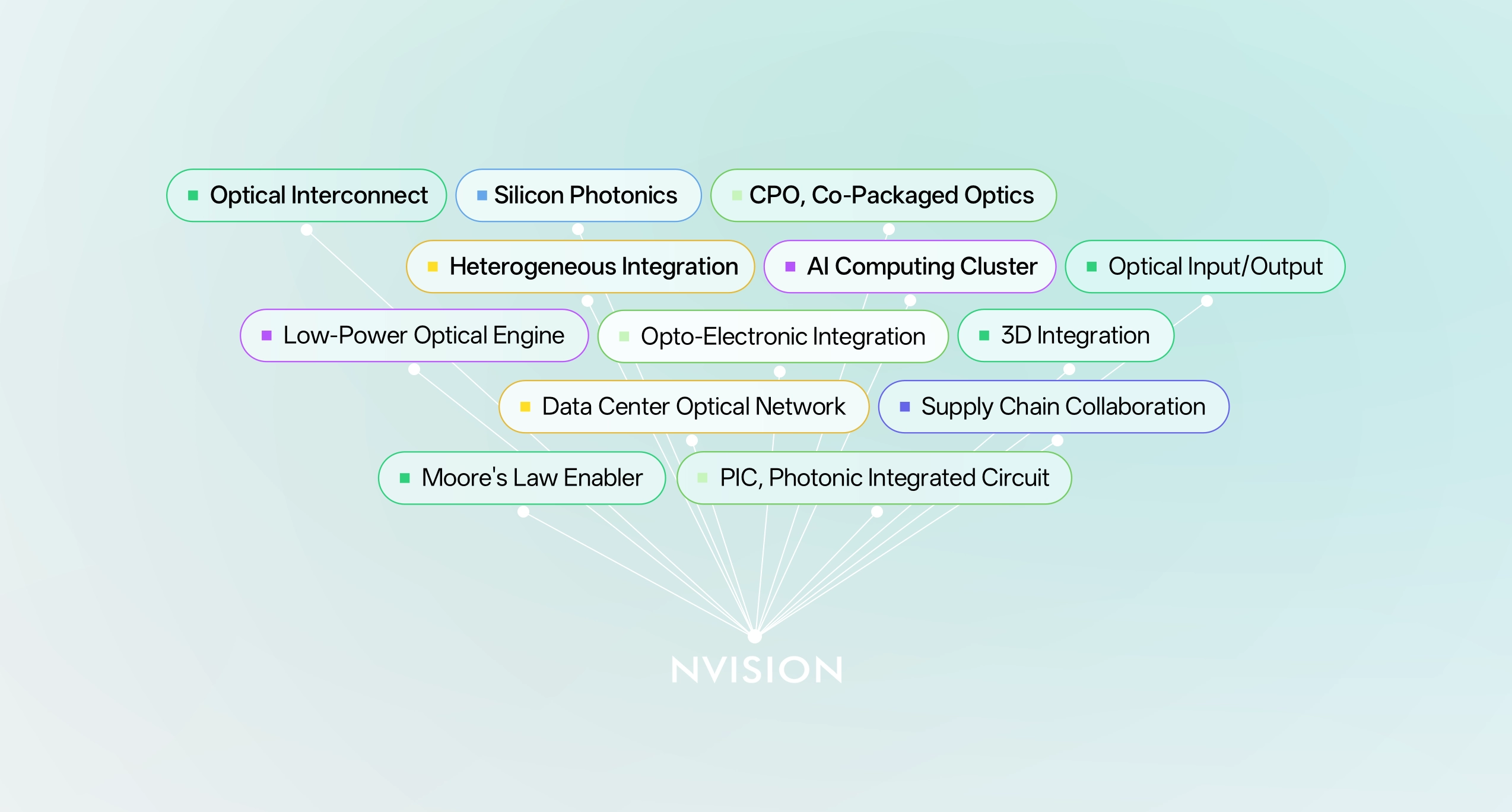
Taking the NVISION project of InnoCore as an example, the company’s core technological focus lies in areas such as optoelectronic integration, silicon photonics chips, data-center optical interconnects, AI computing‑power networks, and low‑energy‑consumption, high‑performance data transmission. Such technologies possess clear industrial value, but without a systematic brand narrative, they risk remaining stuck at the stage of being “highly advanced yet incomprehensible to outsiders.”
STOYARD’s solutions for technology companies begin with their core technologies, building a brand and digital system that combines distinct identity, professional credibility, and communication efficiency.
1. Distilling brand identity from core technologies
Brand design for semiconductor companies should not merely pursue aesthetic formality; it must also reflect the technology itself.
In the Eversilicon project, the brand identity takes “optoelectronic integration” as its design core, seamlessly blending the high-speed dynamics of photons with the stable foundation of electronic systems. The graphic motif is derived from the brand’s initial “N,” which not only stands for NVISION but also subtly evokes meanings such as New, Next, and Nano—each pointing to innovation, the future, and nanometer‑level precision.
This logo design strikes a balance: it retains the simplicity and recognizability essential for tech companies while forging a direct link between the brand’s visual identity and its technological focus.
2. Explain “optoelectronic convergence” using visual language
For silicon photonics chip and optoelectronic integration companies, many core competencies cannot be directly conveyed through ordinary product images. Therefore, the visual system must assume the function of “interpreting technology.”
In this project, the solid block on the left symbolizes silicon-based materials, circuit systems, and the foundational elements of electronic chips; the smooth, curved lines emulate the propagation paths of light waves and the morphology of optical fibers; while the intersection of these graphical elements conveys the heterogeneous integration between photonic and electronic chips.
The value of this design approach lies in the fact that it does not merely render a sense of technology; rather, it transforms the visual elements themselves into microcosms of technological logic. When customers encounter the brand’s visual identity, they perceive speed, precision, integration, and engineering reliability.
3. Establishing a website presentation suitable for advanced manufacturing enterprises
The websites of semiconductor and advanced manufacturing companies must serve multiple audiences simultaneously: prospective customers, investment firms, industry partners, government‑run industrial parks, the media, and job applicants.
Therefore, the official website’s content should not merely introduce “who we are”; it must also clearly answer several key questions:
What industry challenges does the company address?
What are the core technological advantages?
Where are the application scenarios?
Are the team and R&D capabilities trustworthy?
Does the enterprise possess the capacity for sustained growth and industrialization?
In the InnoCore case, the discussion centers on application scenarios such as data-center optical interconnects, 5G communications, artificial intelligence, and infrared detectors, while emphasizing how the company leverages a heterogeneous integration platform to develop both electronic and photonic chips, thereby achieving optoelectronic co-packaging. These features transform the official website from a mere showcase into an essential infrastructure for the company’s external communications.
4. A content system geared toward financing, investment promotion, and market communication
At different stages of their development, technology companies face a range of needs, including financing, market entry, talent recruitment, strategic partnerships, and industry‑wide outreach. A mature brand system must be capable of supporting these scenarios.
Yingweixin was founded in December 2023, and its Shanghai Global R&D Center will be established in March 2025. Leveraging the local semiconductor ecosystem, university research resources, as well as supportive policies and capital, the company aims to accelerate the R&D and industrialization of silicon photonics chips. Such information is crucial for both search engines and target users, as it not only highlights the company’s technological direction but also reflects its position within the industry ecosystem and its stage of development.
Therefore, in solution‑oriented articles, brand design, website development, investor communications, industry positioning, and technical articulation should be integrated into a unified content framework, rather than being treated as discrete visual‑only initiatives.
5. Digital delivery capabilities suitable for semiconductor enterprises
For companies in sectors such as semiconductors, telecommunications, and advanced manufacturing, brand‑building initiatives typically encompass not only visual design but also website development, interactive interfaces, event exhibitions, H5‑based digital campaigns, multilingual content, and ongoing iterations.
STOYARD’s services encompass logo design, website solutions for small and medium-sized enterprises, event and exhibition design, social media marketing, interactive H5 pages, full-stack development, and end-to-end delivery. This combination of capabilities is well-suited for technology companies that need to rapidly establish their brand identity, showcase their technical prowess, and align with the market’s communication cadence.
6. Why do semiconductor companies need professional brand design?
At the surface, competition among semiconductor firms revolves around technology, capital, and supply chains; however, in the commercialization process, brand communication is equally crucial.
A well-defined brand system can help companies:
Enhancing Technological Trustworthiness
Reduce customer comprehension costs
Enhance the efficiency of financing and investment promotion communications
Standardize the messaging across the official website, trade shows, roadshows, and media channels.
Attracting industry partners and high-caliber talent
Enable complex technologies to be expressed in ways that are searchable, shareable, and memorable.
For emerging fields such as silicon photonics chips, optoelectronic integration, and AI data center optical interconnects, whoever can establish a clear brand narrative sooner will be better positioned to take the lead in supply chain and market communications.
For semiconductor and silicon photonics companies, brand design is not about wrapping technology in a layer of visual packaging; rather, it transforms the company’s core competencies into a language that the market can readily understand.
From logo design to website development, and from technical storytelling to digital‑native communications, STOYARD leverages systematic brand and product‑centric digital design to help advanced manufacturing companies establish a clearer, more professional, and more impactful external identity. For semiconductor companies undergoing brand upgrades, building corporate websites, conducting investor outreach, or preparing to expand overseas, a comprehensive brand system that clarifies technical expertise, showcases competitive strengths, and supports long-term communication has become a critical asset in their commercialization journey.
Keywords
Semiconductor brand design, chip company website design, silicon photonics brand design, optoelectronic integration enterprise websites, advanced manufacturing brand design, technology company brand upgrades, semiconductor digital marketing, chip company logo design, data center optical interconnect solutions, and technology company website development.