# GE集团分拆启示:多业务公司,该怎么安排品牌关系 - ID: 96 - URL: https://www.stoyard.com/viewpoint/96 - English URL: https://www.stoyard.com/en/viewpoint/96 - Category: 品牌服务 - English Category: Brand Services - English Title: The diversified development of the group should not endorse the independent business. ## 中文主体 > Interbrand 2026 百强榜里,两家从集团分拆出来的业务拿到了独立估值。集团背书是信任额度的分配,判断标准是客户是否重叠、风险是否同源、品类是否独立;先定实体,再定名字 ## Interbrand 2026 年「全球最佳品牌」百强榜总价值 3.87 万亿美元,同比上涨 8.1%。但今年真正值得看的不是这个数字,而是四家新进榜公司:其中两家根本不是新品牌,只是从原来的集团里切了出来,就拿到了自己的品牌估值——GE HealthCare 与 HPE。 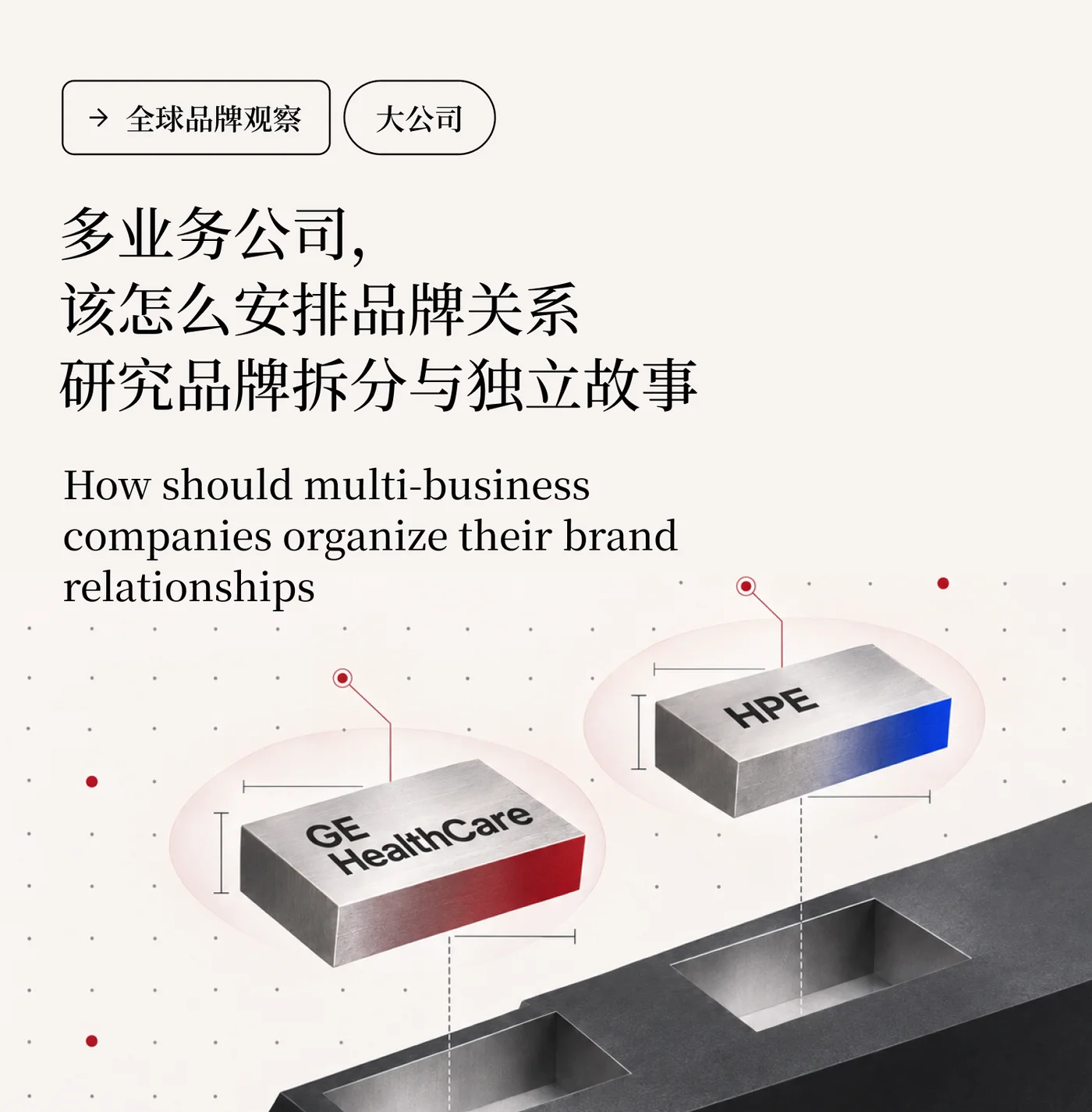 GE HealthCare 与 HPE:从集团分拆后独立进入全球品牌百强(STOYARD 整理示意) Interbrand 于 2026 年 10 月 28 日发布《Best Global Brands 2026》。新进榜四家是 Zurich(58 位)、Hitachi(90 位)、GE HealthCare(95 位)、HPE(99 位);GE HealthCare 是 2023 年从 GE 分拆出的医疗业务,HPE 是 2015 年从惠普分拆出的企业业务。同一年,汽车业品牌价值蒸发 569.5 亿美元:Toyota −19.9%、Honda −21.8%、Nissan −23.2%、Tesla −37.8%。 先说数据的边界:这是按公开财务与品牌收益测算的年度榜单,入榜有门槛——收入要有相当比例来自海外市场,长期经济利润为正。所以它记录的是「能被计价的大品牌」,不含大量区域型 B2B 企业;下面的讨论用它看结构变化,不用它估算单个品牌的资产。 ## 集团拆分自己的业务品牌,背书本身也是需要计算的成本 「给业务背书」的意思是:业务对外表达时,借用集团的信任与历史。它的成本是识别混淆——客户看到同一个名字,会默认这些业务的能力、价格、风险是同一套。 先把边界说清:这里讨论的不是视觉系统,也不是传播口径,而是「谁在外部算一个独立实体」。 集团越大,这笔成本越高。集团层能提供的信任是有限的,背书给十块业务,每块分到的辨识度都会变薄。所以背书从来不是「看起来更大气」的选择,**它是一次额度分配。** ## 三个问题,帮你做品牌架构决策 要不要背书,可以用三个问题衡量: - **客户是否重叠。**同一批客户会同时买两块业务吗?会,就可以背书,因为对方只需要记一个名字;不会,分开更容易被找到。 - **风险是否同源。**一块业务出事,会不会连带另一块的声誉?会,就该在实体层隔开,而不是靠声明隔开。 - **品类是否独立。**两块业务会不会出现在同一份采购清单里?会,就必须各有自己的品类词,不能共用一个名字。 三个答案组合起来才是结构,而不是单看一条。客户全重叠、风险同源、品类各自独立,对应的是「集团背书 + 独立品类词」;客户不重叠、风险需要隔离,对应的是「业务独立成实体」。 这里最常见的误判,是把背书当审美题。它其实是判断题:**借出的信任要还利息,利息就是每块业务都要多花力气解释自己是谁。** ## AI 怎么判断一家公司是否可用 先说清楚一件事:现在客户找供应商之前,往往先问 AI 一句。AI 的回答由两类材料组成——它已经掌握的外部公开信息,和它当场检索到的官网内容。两类材料用在不同问题上。 第一组数据来自 5W Research,2026 年 11 月 20 日的实测:24 个关于品牌、归属关系的问题,在 ChatGPT、Gemini、Perplexity、Claude 上各跑三次,共 288 条回答,285 条带检索证据。结果有点意外:被点名最多的微软和苹果,自家官网一次都没被引用(0/285);被引用最多的是维基百科(15.1%)、Kantar(14%)、Interbrand(9.5%)。也就是说,在「这家公司是谁、属于哪个集团」这类问题上,AI 主要参考的是外部已经写好、可以交叉核对的公开材料,而不是官网自己说的话。 第二组数据来自 Hotwire 与 The House of Beautiful Business,2026 年 11 月 18 日发布,覆盖 6 个引擎、超过 100 万条回答、62,091 个 B2B 科技域名:在「谁能解决这个问题」这类选型问题上,**企业官网**占了引用来源的 71%。 这两组数字看着相反,其实是两种问题:问「这家公司怎么样」,它翻外部材料;问「谁能解决我的问题」,它读官网和文档。 对品牌架构的含义很直接:集团和业务是什么关系、谁属于谁,这类信息属于前一种——AI 不会只听官网怎么说,它要在外部材料里看到一致的说法。如果百科、榜单、官网三处写的父子关系对不上,AI 只能挑其中一种说法,客户看到的品牌关系就是乱的。 ## 子品牌分拆出去之后,品牌资产怎么留下来 组织图可以一夜改完,品牌资产不能。认知、信任、搜索份额,都挂在原来的实体名下。 HPE 独立后仍带着「HP」,GE HealthCare 保留「GE」,这是继承资产;但同时它们各自建立了品类词与事实页,否则外部仍会把它们当作「某集团的一块业务」。榜单的门槛说明了同一件事:只有当一块业务能独立说明自己的收入来源与业务边界,它的品牌价值才可能被单独计价。 **名字可以改得很快,关系写不清楚就永远算不清。** ## 先定实体,再定名字 那么比较务实的判断还是:先定实体,再定名字。顺序反了,名字会反复改,资产却一直挂在原地。 落到执行是三件事: - 列一份实体清单:上级是谁、做什么、不做什么、和谁同类。 - 用三个问题分组:客户重叠、风险同源、品类独立,得出「背书」还是「分开」。 - 把这份清单在三处写一致:官网信息架构、结构化数据、外部百科与榜单。 STOYARD Insight** 多业务公司的品牌架构,本质是在实体关系、用户认知与外部可检索信息之间找平衡。STOYARD 在集团品牌与业务品牌项目中,协助客户梳理实体清单、设计背书与独立品牌路径,并让官网信息架构、结构化数据与外部口径保持一致,帮助品牌资产在分拆与扩张中持续沉淀。 **关键词**: 品牌架构、集团品牌、子品牌分拆、品牌背书、B2B 品牌、AI 品牌引用、Interbrand、品牌资产、多业务公司、品牌战略 **分类**: 品牌战略 / AI 趋势 / 集团品牌 / 案例观察 **资料来源**: [1] Interbrand,《Best Global Brands 2026》,2026-10-28(PR Newswire 报道)。[prnewswire.com](https://www.prnewswire.com/news-releases/brands-turning-strength-into-action-pull-ahead-in-interbrands-best-global-brands-2026-302919588.html) [2] Interbrand,《Best Global Brands 2026》榜单页。[interbrand.com](https://www.interbrand.com/best-global-brands/) [3] 5W Research,《Microsoft and Apple Led AI Mentions. Neither Site Was Cited》,2026-11-20。[5wpr.com](https://www.5wpr.com/research/ai-brand-mentions-citation-gap/) [4] Hotwire / The House of Beautiful Business,《Visibilidad en la era de la IA》,2026-11-18(Anuncios 报道)。[anuncios.com](https://www.anuncios.com/otras-noticias/noticia/1196212035001/el-71-de-las-fuentes-que-cita-la-ia-en-sus-respuestas-sobre-marcas-b2b-son-webs-corporativas.1.html) ## English Content > In the Interbrand 2026 Top 100 list, two businesses spun off from the group received independent valuations. Group endorsement is the allocation of trust limit, the criteria are whether the customer overlaps, whether the risk is the same source, whether t ## The total value of the "World's Best Brands" 100 in Interbrand 2026 is $3.87 trillion, up 8.1 percent year-on-year. But what is really worth watching this year is not this number, but the four new companies on the list:Two of them are not new brands at all. They just cut out from the original group and got their own brand valuations-GE HealthCare and HPE.  GE HealthCare and HPE: Independent entry into the top 100 global brands from the spin-off of the group (STOYARD finishing) Interbrand released “Best Global Brands 2026” on October 28, 2026. The four new ones on the list are Zurich(58), Hitachi(90), GE HealthCare(95) and HPE(99). GE HealthCare is a medical business split from GE in 2023 and HPE is an enterprise business split from HP in 2015. In the same year, the automotive industry lost $56.95 billion in brand value: Toyota − 19.9 per cent, Honda − 21.8 per cent, Nissan − 23.2 per cent, Tesla − 37.8 per cent. First, let’s define the scope of the data: this is an annual ranking based on publicly disclosed financials and brand revenue. There are entry criteria—revenue must derive a significant share from overseas markets, and long-term economic profit must be positive. Therefore, it captures “well‑known brands that can be valued,” excluding a large number of regional B2B firms; the following analysis uses this dataset to examine structural changes, but not to estimate the assets of individual brands. ## The group splits its its own business brand, and the endorsement itself is a cost that needs to be calculated. “Backed by the business” means that when the business communicates externally, it leverages the group’s trust and track record. Its cost lies in identifying confusion—when customers see the same name, they assume that the capabilities, pricing, and risks of these businesses are identical. Let’s first clarify the boundaries: this discussion is not about the visual system, nor about communication channels; rather, it concerns “who counts as an independent entity on the outside.” The larger the group, the higher this cost. The trust that the group level can provide is limited; when it endorses ten business units, the distinctiveness of each unit becomes diluted. So endorsement is never a "look more atmospheric" choice,**It is a quota allocation.** ## Three Questions to Help You Make Brand Architecture Decisions Endorsement or not can be measured by three questions: - **Whether customers overlap.**Will the same customers buy two services at the same time? If yes, it can be endorsed, because the other party only needs to record one name; if not, keeping them separate makes them easier to locate. - **Whether the risks are of the same origin.**If one line of business runs into trouble, could it drag down the reputation of another? Yes—it should be segregated at the operational level, not merely through declarations. - **Is the category independent?**Can two business lines appear on the same procurement list? If so, they must each have their own category term and cannot share the same name. The structure emerges only when the three answers are considered together, not when looking at any single one in isolation. Full customer overlap, shared risk sources, and independent product categories correspond to “group endorsement with independent category terms”; non-overlapping customers and the need for risk isolation correspond to “business entities operating independently.” The most common misjudgment here is treating endorsement as an aesthetic issue. It is actually a judgment question:**The trust lent has to pay interest, and the interest is that each business has to spend more effort explaining who it is.** ## How do AI tell if a company is available? Let me make one thing clear: nowadays, before contacting a supplier, customers often ask AI first. The AI’s response consists of two types of material—external publicly available information it has already mastered, and official website content it retrieves on the spot. The two types of materials are used for different problems. The first dataset is from 5W Research, based on measurements taken on November 20, 2026: 24 questions about brands and affiliations were run three times each on ChatGPT, Gemini, Perplexity, and Claude, yielding a total of 288 responses, 285 of which included retrieved evidence. The results were somewhat unexpected: Microsoft and Apple, which were mentioned most frequently, weren’t cited even once on their own official websites (0/285); the most frequently cited sources were Wikipedia (15.1%), Kantar (14%), and Interbrand (9.5%). In other words,On questions like "who is this company and what group does it belong to", AI mainly refer to public materials that have been written outside and can be cross-checked.Not what the official website says. The second dataset is from Hotwire and The House of Beautiful Business, released on November 18, 2026, covering six engines, over one million responses, and 62,091 B2B technology domain names:When it comes to choice problems like “Who can solve this problem,”**Corporate Website**Accounting for 71% of the cited sources. These two sets of numbers may seem opposite, but they actually reflect two different types of questions: when asked “How is this company?”, it consults external materials; when asked “Who can solve my problem?”, it refers to the official website and documentation. The meaning of brand architecture is very straightforward: what is the relationship between the group and its businesses, and who belongs to whom—this kind of information falls into the former category. AI won’t just take the official website at its word; it needs to see consistent messaging in external materials as well. If the father-son relationship described in the encyclopedia, on the leaderboard, and on the official website doesn’t match, the AI can only pick one of these accounts, and the brand relationship the customer sees will be inconsistent. ## How can brand equity be preserved after a sub-brand is spun off? An org chart can be revamped overnight; brand equity cannot. Cognition, trust, and search share all remain under the original entity name. After spinning off, HPE retained “HP,” and GE HealthCare kept “GE”; these are inherited brand elements. At the same time, each company established its own category terms and fact pages; otherwise, outsiders would still view them as merely “a business unit of a larger group.” The threshold for inclusion on the list underscores the same point: a business unit’s brand value can be assessed separately only if it can independently define its revenue streams and operational boundaries. **Names can be changed quickly, but if relationships aren’t clarified, they’ll remain unclear forever.** ## First define the entity, then define the name. Then the more pragmatic judgment is still: first determine the entity, then the name. The order is reversed, the name keeps getting changed, but the assets remain where they were. When it comes to execution, there are three things: - Compile an entity list: who the superior is, what they do, what they don’t do, and who they are similar to. - Group them into three categories using the questions: customer overlap, shared risk sources, and independent product categories, to determine whether to “endorse” or “separate.” - Ensure this list is consistent across three sources: the official website’s information architecture, structured data, and external encyclopedias and rankings. The essence of the brand architecture of a multi-business company is to find a balance between entity relationships, user perception and externally retrievable information. In the Group's brand and business brand projects, the STOYARD assists customers in sorting out entity lists, designing endorsements and independent brand paths, and aligning the official website information architecture and structured data with external calibers to help brand assets continue to precipitate in the spin-off and expansion. **Keywords**: Brand architecture, group brand, sub-brand spin-off, brand endorsement, B2B brand, AI brand reference, Interbrand, brand equity, multi-business company, brand strategy **Category**: Brand Strategy/AI Trend/Group Brand/Case Study **Source of Information**: [1] Interbrand, Best Global Brands 2026, 2026-10-28(PR Newswire).[prnewswire.com](https://www.prnewswire.com/news-releases/brands-turning-strength-into-action-pull-ahead-in-interbrands-best-global-brands-2026-302919588.html) [2] Interbrand, “Best Global Brands 2026” ranking page.[interbrand.com](https://www.interbrand.com/best-global-brands/) [3] 5W Research,《微软和苹果引领人工智能相关提及量。两个网站均未被引用》,2026-11-20。[5wpr.com](https://www.5wpr.com/research/ai-brand-mentions-citation-gap/) [4] Hotwire / The House of Beautiful Business, “Visibility in the Age of AI,” 2026-11-18 (Advertising Report).[anuncios.com](https://www.anuncios.com/otras-noticias/noticia/1196212035001/el-71-de-las-fuentes-que-cita-la-ia-en-sus-respuestas-sobre-marcas-b2b-son-webs-corporativas.1.html)