# 企业官网的GEO落地:从“被点击”到“被引用” - ID: 91 - URL: https://www.stoyard.com/insights/91 - English URL: https://www.stoyard.com/en/insights/91 - Category: AI 探索 - English Category: AI Exploration - English Title: From “Being Clicked” to “Being Cited”: A GEO Implementation Checklist for Corporate Websites ## 中文主体 > 机器流量超过人类之后,官网的竞争单位从“页面排名”降到了“段落引用”。这篇文章不谈概念,给一份可以照着做的六步清单,以及三件不要做的事。  我们在《AI 时代首个互联网拐点出现:机器人阅读访问量首次超越人类》里讨论过一个变化:机器正在成为网站越来越重要的“读者”。那篇文章给的是判断。 判断之后,客户问得最多的一句是:“那我们的官网,具体要改什么?” **这篇文章试着回答这个问题。不谈趋势,谈动作。 ## 先把问题定义清楚: GEO 优化的到底是什么 传统 SEO 优化的是“位置”——用户在搜索结果页里,你的链接排第几,有没有被点。 GEO(Generative Engine Optimization,生成式引擎优化)优化的不是位置,而是“是否被引用、被怎么描述”**。用户可能一次都不点开你的网站,但他从 AI 的回答里形成了一个关于你的印象。这个印象,就是新的品牌入口。  这件事有3个链路组成 被发现:**爬虫抓得到、索引建得起来。 被理解:**页面内容能被切成可以独立成立的段落,实体关系清楚。 被采用:**那段话足够可信、足够具体,值得被放进答案里。 有一点容易被忽略:生成式答案能够呈现的来源有限,真正进入答案的往往不是整篇页面,而是其中一段可以直接支撑结论的内容。** **也就是说,竞争单位正从“页面”缩小到“段落”。首页做得再好,如果没有一句话或一段内容能被单独摘出、离开原页面后仍然成立,它就很难进入答案层。** ## 第一步: 确认你没被自己的 robots.txt 挡住 **首先简单了解一下什么是:robots.txt** 这其实就是一个信息文本,是放在网站根目录的纯文本文件,给搜索引擎爬虫(蜘蛛、bot)看的 “访问说明书”,全称:**Robots Exclusion Protocol(爬虫排除协议)**Google for...。 地址固定:https://你的域名/robots.txt 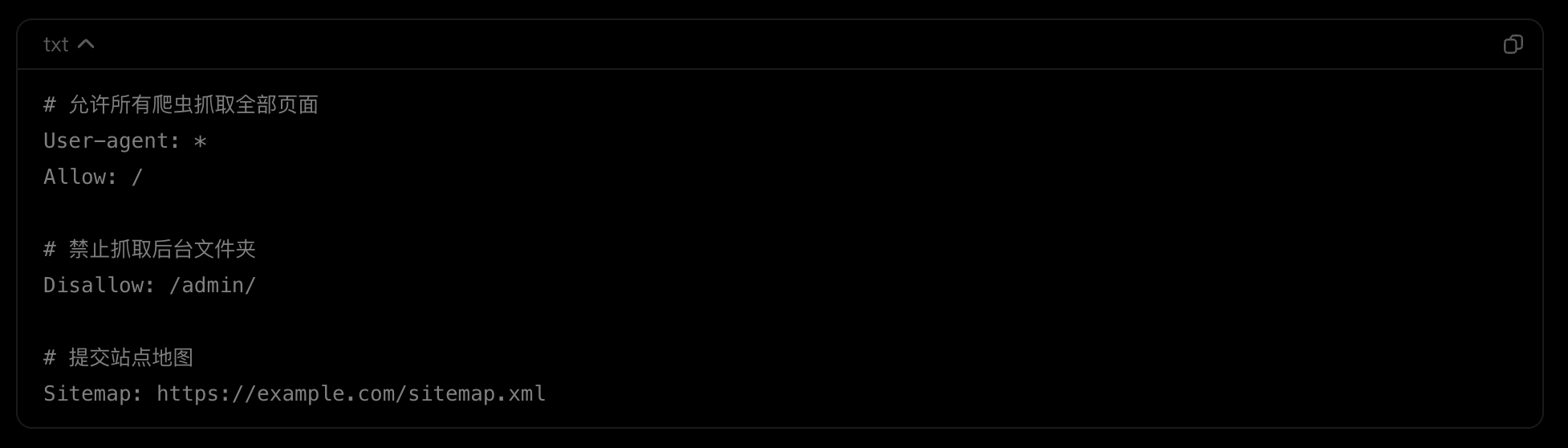 ** **robots.txt 例子,****国内大部分模版搭建的网站(非专业定制的企业站点)可能都没有这个文件。 训练型**(把你的内容用于训练模型): 如 OpenAI 的 GPTBot、Anthropic 的 ClaudeBot、Google 的 Google-Extended。 检索型**(实时抓取用于回答用户问题): 如 OpenAI 的 OAI-SearchBot、Anthropic 的 Claude-SearchBot、Perplexity 的 PerplexityBot。 很多企业一刀切地 Disallow 所有用户代理,等于把模型训练与实时检索一起关掉。更合理的做法是分别评估:训练型爬虫可以依据版权、合规和商业策略决定是否开放;如果企业希望内容进入相应 AI 产品的检索答案,则应允许其检索型爬虫访问公开页面。 除 robots.txt 之外,还有四个更隐蔽的拦截点: - WAF 与反爬策略**把合法爬虫误杀; - 全站 SPA,正文靠 JavaScript 渲染,抓到的 HTML 是空壳; - 关键参数、认证信息放在需要点击、悬停或登录之后才出现; - 分页把规格表拆成十几页,每页都缺上下文。 核验方法**很朴素:先按各家官方文档核对用户代理,再检查几个关键页面能否正常返回 200、正文是否出现在可解析的 HTML 中,同时确认 WAF 日志没有把合法请求误判为攻击。一次基础排查通常不需要很久,却可能比继续修改视觉更接近问题根源。 **基于目前的AI检索数据的大趋势下,robots.txt的定位与价值需要重新评估。** ## 第二步: 把页面写成“可以被单独引用的一段话” AI 采用内容的方式是抽取,不是通读。  ### ### 规则一:每段一个结论,段首就是结论 不要铺垫三段再给答案。第一句就是判断,后面才是条件和展开。被摘走的第一句,必须自己站得住。 ### 规则二:删掉所有依赖上下文的指代 “如上所述”“如下图所示”“该产品”“此项能力”——这些词在原文里通顺,被摘出来就是废句。写全主体:“Pandar64 的垂直视场角为……”。 ### 规则三:小标题写成客户真的会问的问题 “技术优势”是内部语言;“在零下20度的环境里还可以充电吗?”是客户语言。问题式标题下面第一段直接给答案,40 到 80 字,然后再展开论证。 ## 第三步: 让“你是谁”在全网只有一个版本 AI 系统需要依靠名称、属性和关联信息识别实体。如果官网、媒体稿与行业数据库对同一家公司的描述长期互相冲突,系统就更难确认这些信息是否指向同一个主体,也更难判断哪个版本可信。 需要统一的至少有六项: - 法定名称与英文名(含大小写与缩写规则); - 成立年份、总部所在地、规模口径; - 产品型号的命名规则(不要一个产品三个写法); - 认证与资质的全称与编号; - 客户与合作伙伴名称的官方写法; - 融资、估值、产能这类容易被二手信息写错的数字。 技术上,可以用结构化数据明确表达这些关系:用 Organization 描述公司,并通过 sameAs 关联经过确认的官方账号或权威资料;用 Product / Service 描述产品与服务;用 BreadcrumbList 说明页面层级;用 Article 标注文章类型、作者与更新时间。结构化数据必须与页面可见内容一致,不能把页面上没有的信息藏进标记中。 这里要提醒一句:Google 已将 FAQ 富媒体结果主要限制在权威的政府和健康网站,普通企业站不应再把 FAQ 标记当成获取展示位的通用技巧。**结构化数据更稳定的价值,是把页面中的主体、属性与关系表达清楚。为了富媒体展示批量堆砌问答,是过时的打法;为了减少机器理解歧义去做,才有长期意义。 ## 第四步: 建立一个“事实源”,而不是让每个人各写一版 GEO 的成败,50%在组织内部。 参数表、认证清单、客户名单、案例结果——这四类内容需要明确唯一负责人,并指向同一套经过确认的源数据。市场部写文案、产品部给参数、法务审资质、海外团队改英文,如果没有共同的事实源,页面之间很快就会互相矛盾。冲突信息越多,机器和人就越难判断哪个版本可信。 两个低成本动作: - 给关键页面加“最后更新时间”**, 并真的更新。时效性是可信度的一部分。 - 让产品页能被非技术人员在 15 分钟内更新。 **内容如果只能靠开发改,实际上就是死的。 **这个时候可能更需要一个完善的企业知识库来作为支持企业内容团队协作,同步使用最新的企业信息与资料下载,尽量避免内容不对齐的情况,飞书文档是一个好的解决方案之一。** ## 第五步: 建立一个llms.txt (需要观察是否被访问进行下一步的优化) llms.txt 是**给大模型(LLM / AI Agent)看的精选文档(2024 年 9 月由 Jeremy Howard(Answer.AI)提出,属于社区约定,不是强制国际标准)**,在站点根目录放置一个 Markdown 文件,用简明结构告诉大模型“这个站点有什么、哪些内容重要”。它不是正式的互联网标准,各家产品是否读取、如何使用也并不统一。 我们的建议是:可以试,实施成本不高,但优先级应排在前面四步之后。上线后也要通过日志或实际测试观察它是否被访问,不能把“文件已存在”当成“引擎已采用”。 因为它解决的是“机器怎么更快读懂你的站点结构”,而前面四步解决的是“你有没有东西可以被读懂”。地基没打好,地图画得再漂亮也没用。 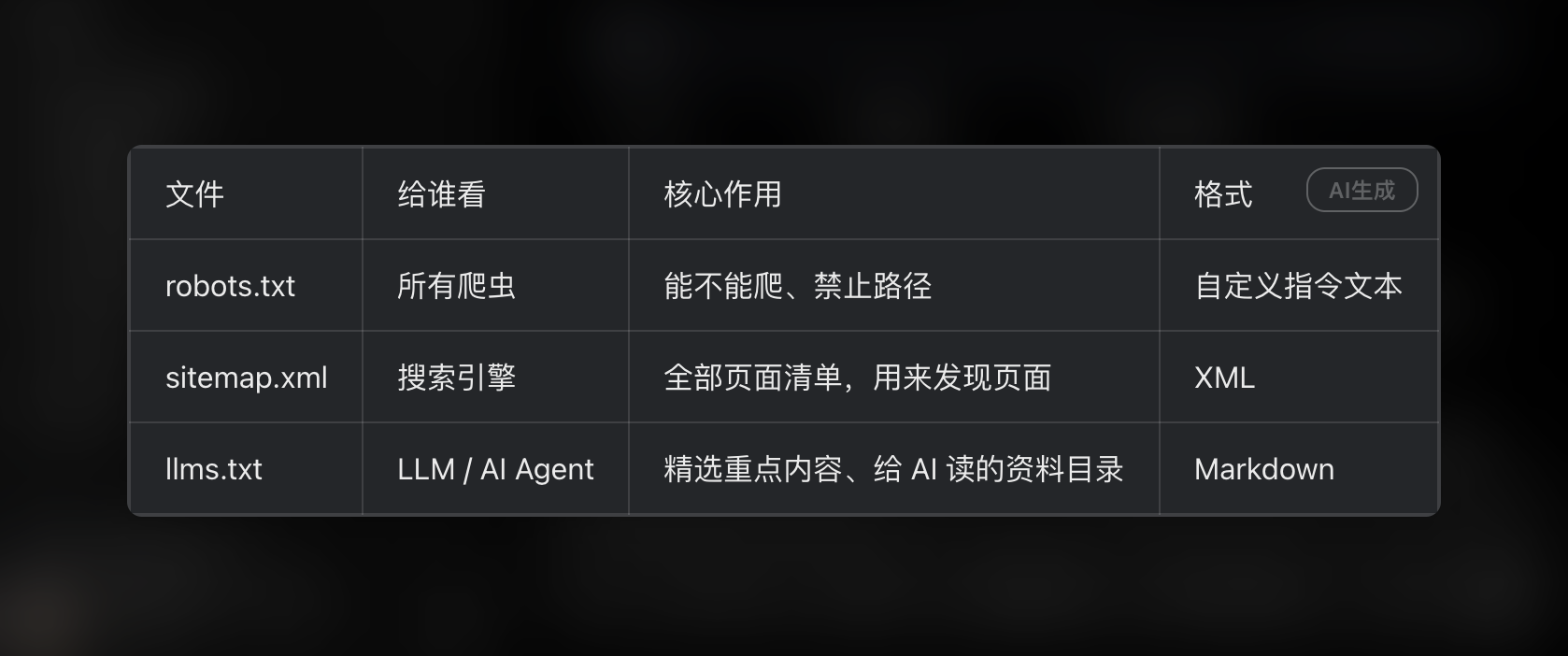 ## 第六步: 把衡量指标换掉 传统的曝光、点击、排名,回答不了真正关心的问题:“AI 提到我们的时候,说得对不对?”** 一个可执行的做法是:固化一份 30 到 50 个问题的清单,全部来自真实客户在销售场景里问过的话,并按产品、场景、地域和竞品对比分组。每月在选定的主流引擎中使用一致的测试条件运行一次,至少记录以下五个字段: - 是否被提及; - 是否被引用(有没有给出你的链接或名称); - 描述是否准确(定位、参数、区域能力); - 引用了哪一页; - 竞品是否被放在你前面,理由是什么。 连续记录三个月,你会得到一份能够观察变化的“答案层体检表”。它同时也是一份内容选题清单:描述不准确、缺少来源或长期未被提及的问题,就是下一批页面应优先补足的地方。 ## 三件不要做的事 ##  ## 结语 官网的 KPI 正在悄悄改变。 ### 过去是“有多少人来”,现在是“来的人和机器,能不能正确复述我们是谁”。 前一个指标可以被投放买来, 后一个只能靠内容结构一点一点建起来。 这也是为什么我们一直把官网当作经营基础设施, 而不是一次性的形象工程。 ### 判断已经被验证了。接下来是基本功。** ## English Content > Once machine traffic surpasses human traffic, the competitive battleground for official websites has shifted from “page rank” to “paragraph citation.” This article doesn’t delve into concepts; instead, it provides a six-step checklist you can follow and t  In “The First Internet Inflection Point of the AI Era Has Arrived: Robot Traffic Surpasses Human Traffic for the First Time,” we discussed a shift: machines are becoming increasingly important “readers” of websites. That article provides a judgment. After the assessment, the most common question customers ask is:“So what exactly do we need to change on our official website?” **This article attempts to answer this question. Let’s talk about actions, not trends. ## First, clearly define the problem: What exactly is GEO-optimized? Traditional SEO optimizes for “position”—where your link appears on the search results page and whether it gets clicked. GEO (Generative Engine Optimization) optimizes not positions, but rather“Whether it is cited and how it is described”**. A user may never click on your website, but they form an impression of you from AI’s response. This impression serves as the new brand entry point.  This matter consists of three links. Discovered:**The crawler can fetch the data, and the index can be built. Understood:**The page content can be divided into self-contained paragraphs, with clear entity relationships. Adopted:**That passage is credible and specific enough to be included in the answer. One point that is easily overlooked:The sources that can be cited in generative answers are limited; the content that actually appears in the answer is often not an entire page, but rather a specific excerpt that directly supports the conclusion.** **In other words, the competitive unit is shrinking from the “page” level to the “paragraph” level. No matter how well a homepage is designed, if it lacks a single sentence or piece of content that can be excerpted and still hold true outside its original context, it will struggle to make it into the answer layer.** ## Step one: Make sure you’re not blocked by your own robots.txt file. **First, let’s briefly understand what robots.txt is:** This is essentially an informational text—a plain-text file placed in the root directory of a website—serving as a “visitation guide” for search engine crawlers (spiders, bots). Its full name is:**Robots Exclusion Protocol (Crawler Exclusion Protocol)**Google for...。 Fixed address:https://你的域名/robots.txt  ** **robots.txt example,****Most websites built with templates in China (non‑professionally customized corporate sites) may not have this file. Training type**(Use your content to train the model): Such as OpenAI’s GPTBot, Anthropic’s ClaudeBot, and Google’s Google-Extended. Retrieval type**(Real-time scraping used to answer user questions): Such as OpenAI’s OAI-SearchBot, Anthropic’s Claude-SearchBot, and Perplexity’s PerplexityBot. Many companies take a one-size-fits-all approach Disallow All user agents effectively disable both model training and real-time retrieval. A more reasonable approach is to assess each case separately: training crawlers can be allowed or blocked based on copyright, compliance, and business strategy; if a company wants its content to appear in the search results of the relevant AI product, it should permit retrieval crawlers to access public pages. In addition to robots.txt, there are four more hidden interception points: - WAF and Anti-Crawling Strategies**Mistakenly blocking legitimate crawlers; - Single-page application (SPA) for the entire site; the main content is rendered via JavaScript, so the fetched HTML is just a skeletal shell. - Key parameters and certification information are displayed only after clicking, hovering, or logging in. - The specification sheet is split across more than a dozen pages, with each page lacking contextual information. Verification Method**It’s straightforward: first, verify the user agent against each vendor’s official documentation; then, check that several key pages return a 200 OK status and that their content appears in parsable HTML; finally, confirm that the WAF logs are not misclassifying legitimate requests as attacks. A basic troubleshooting session usually doesn’t take long, yet it may get you closer to the root cause of the problem than continuing to tweak the visuals. **Based on the current overarching trend of AI retrieval data, the positioning and value of robots.txt need to be reassessed.** ## The second step: Write the page as “a passage that can be cited independently.” AI uses an extraction approach rather than a full-reading one.  ### ### Rule 1: Each paragraph should have one conclusion, and the conclusion should appear at the beginning of the paragraph. Don’t set up three paragraphs before giving the answer. The first sentence is a judgment; the conditions and elaboration come afterward. The first sentence you choose must stand on its own. ### Rule 2: Remove all context-dependent references. “as mentioned above,” “as shown in the figure below,” “this product,” “this capability”—these phrases sound fine in context, but when taken out of it, they become awkward fragments. Write the full subject: “Pandar64’s vertical field of view is…” ### Rule 3: Write subheadings as questions your customers would actually ask. “Technical advantage” is internal jargon; “Can it still charge in a -20°C environment?” is customer language. For question-style headlines, provide the answer directly in the first paragraph—40 to 80 words—and then expand with supporting arguments. ## Step 3: Ensure there is only one version of “Who are you?” across the entire internet. AI systems need to rely on names, attributes, and associated information to identify entities. If the official website, press releases, and industry databases consistently provide conflicting descriptions of the same company, it becomes more difficult for the system to determine whether these sources refer to the same entity and to assess which version is reliable. There are at least six items that require standardization: - Legal name and English name (including capitalization and abbreviation rules); - Year of establishment, headquarters location, and scale metrics; - Product model naming conventions (avoid having three different ways to write the same product); - The full names and numbers of certifications and qualifications; - The official spelling of customer and partner names; - Numbers like funding amounts, valuations, and production capacity are prone to inaccuracies in secondhand reports. Technically, these relationships can be explicitly expressed using structured data: by using Organization Describe the company and through sameAs Link to a verified official account or authoritative source; use Product / Service Describe products and services; use BreadcrumbList Explain the page hierarchy; use Article Indicate the article type, author, and update time. Structured data must match the visible content on the page; do not embed information in markup that is not actually present on the page. Here’s a word of caution:Google has largely restricted FAQ rich results to authoritative government and health websites; businesses should no longer treat FAQ markup as a generic tactic for earning featured snippets.**The more stable value of structured data lies in clearly representing the entities, attributes, and relationships within a page. Piling up Q&As in bulk for rich-media displays is an outdated approach; only by addressing the ambiguities of machine understanding can we achieve lasting value. ## Step 4: Establish a single “source of truth” instead of having everyone write their own version. 50% of GEO’s success or failure lies within the organization. Parameter tables, certification lists, customer lists, and case outcomes—these four types of content require clearly designated single owners and must reference the same set of validated source data. The marketing team writes the copy, the product team provides the specs, legal reviews the qualifications, and the overseas team edits the English; without a shared source of truth, the pages will quickly contradict one another. The more conflicting information there is, the harder it becomes for both machines and humans to determine which version is trustworthy. Two low-cost actions: - Add a “Last Updated” timestamp to key pages.**, And it really updates. Timeliness is part of credibility. - Enable non-technical users to update product pages within 15 minutes. **If content can only be modified through development, it is essentially static. **At this point, a robust enterprise knowledge base may be especially needed to support collaboration among content teams, enable synchronized access to the latest corporate information and document downloads, and minimize content misalignment. Feishu Docs is one effective solution.** ## Step 5: Create an llms.txt file (further optimization will depend on whether it is accessed). llms.txt is**Curated Documents for Large Models (LLMs/AI Agents) (proposed by Jeremy Howard of Answer.AI in September 2024; a community convention, not a mandatory international standard)**, Place a Markdown file in the site’s root directory to use a concise structure to tell the large model “what this site is about and which content is important.” It is not an official Internet standard, and there is no uniformity across vendors regarding whether their products can read it or how they choose to use it. Our recommendation is: it’s worth a try, as the implementation cost is low, but its priority should be after the first four steps. Even after deployment, you should monitor access via logs or real-world testing; don’t mistake “file exists” for “engine has been adopted.” Because it addresses the question of “how to enable machines to understand your site’s structure more quickly,” whereas the first four steps address whether “you even have content that can be understood.” If the foundation isn’t solid, no amount of beautiful map design will matter.  ## Step Six: Replace the metrics Traditional metrics like impressions, clicks, and rankings fail to address the questions that truly matter:“Did AI get it right when it mentioned us?”** A practical approach is to standardize a list of 30 to 50 questions, all drawn from actual customer inquiries in sales scenarios, and group them by product, use case, region, and competitive comparison. Run once a month under consistent test conditions on selected mainstream engines, recording at least the following five fields: - Whether it is mentioned; - Whether it has been cited (whether your link or name has been provided); - Whether the description is accurate (positioning, parameters, regional capabilities); - Which page was cited? - Are competitors placed ahead of you, and what is the reasoning? If you keep records for three consecutive months, you’ll have an “answer-layer health checkup” that lets you track changes. It also serves as a list of content topics: issues that are inaccurately described, lack sources, or have long gone unmentioned are the areas that should be prioritized for improvement in the next round of page updates. ## Three Things Not to Do ##  ## Conclusion The KPIs on the official website are quietly changing. ### In the past, it was about “how many people show up”; now, it’s about whether the people and machines that come can accurately articulate who we are. The previous metric can be purchased through ad placements, The latter can only be built up bit by bit through its content structure. That’s why we’ve always treated our official website as a core operational infrastructure. Rather than a one-off vanity project. ### The judgment has been verified. Next up are the fundamentals.**