
From “Being Clicked” to “Being Cited”: A GEO Implementation Checklist for Corporate Websites
In “The First Internet Inflection Point of the AI Era Has Arrived: Robot Traffic Surpasses Human Traffic for the First Time,” we discussed a shift: machines are becoming increasingly important “readers” of websites. That article provides a judgment.
After the assessment, the most common question customers ask is:“So what exactly do we need to change on our official website?”
This article attempts to answer this question. Let’s talk about actions, not trends.
First, clearly define the problem:
What exactly is GEO-optimized?
Traditional SEO optimizes for “position”—where your link appears on the search results page and whether it gets clicked.
GEO (Generative Engine Optimization) optimizes not positions, but rather“Whether it is cited and how it is described”. A user may never click on your website, but they form an impression of you from AI’s response. This impression serves as the new brand entry point.
This matter consists of three links.
Discovered:The crawler can fetch the data, and the index can be built.
Understood:The page content can be divided into self-contained paragraphs, with clear entity relationships.
Adopted:That passage is credible and specific enough to be included in the answer.
One point that is easily overlooked:The sources that can be cited in generative answers are limited; the content that actually appears in the answer is often not an entire page, but rather a specific excerpt that directly supports the conclusion.
In other words, the competitive unit is shrinking from the “page” level to the “paragraph” level. No matter how well a homepage is designed, if it lacks a single sentence or piece of content that can be excerpted and still hold true outside its original context, it will struggle to make it into the answer layer.
Step one:
Make sure you’re not blocked by your own robots.txt file.
First, let’s briefly understand what robots.txt is: This is essentially an informational text—a plain-text file placed in the root directory of a website—serving as a “visitation guide” for search engine crawlers (spiders, bots). Its full name is:Robots Exclusion Protocol (Crawler Exclusion Protocol)Google for...。 Fixed address:https://你的域名/robots.txt
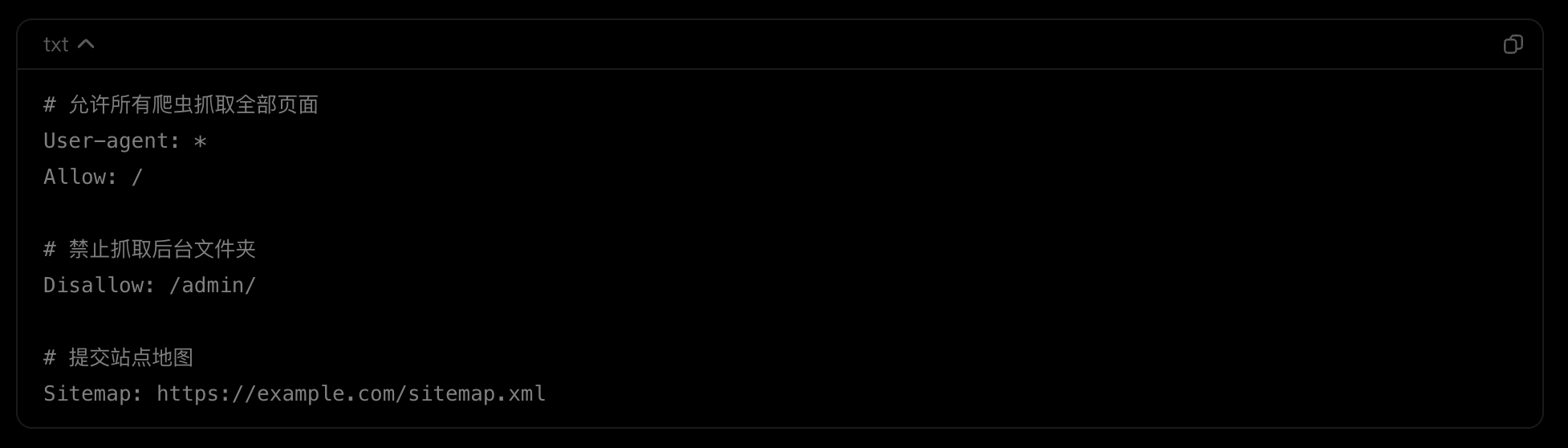
robots.txt example,Most websites built with templates in China (non‑professionally customized corporate sites) may not have this file.
Training type(Use your content to train the model):
Such as OpenAI’s GPTBot, Anthropic’s ClaudeBot, and Google’s Google-Extended.
Retrieval type(Real-time scraping used to answer user questions):
Such as OpenAI’s OAI-SearchBot, Anthropic’s Claude-SearchBot, and Perplexity’s PerplexityBot.
Many companies take a one-size-fits-all approach Disallow All user agents effectively disable both model training and real-time retrieval. A more reasonable approach is to assess each case separately: training crawlers can be allowed or blocked based on copyright, compliance, and business strategy; if a company wants its content to appear in the search results of the relevant AI product, it should permit retrieval crawlers to access public pages.
In addition to robots.txt, there are four more hidden interception points:
- WAF and Anti-Crawling StrategiesMistakenly blocking legitimate crawlers;
- Single-page application (SPA) for the entire site; the main content is rendered via JavaScript, so the fetched HTML is just a skeletal shell.
- Key parameters and certification information are displayed only after clicking, hovering, or logging in.
- The specification sheet is split across more than a dozen pages, with each page lacking contextual information.
Verification MethodIt’s straightforward: first, verify the user agent against each vendor’s official documentation; then, check that several key pages return a 200 OK status and that their content appears in parsable HTML; finally, confirm that the WAF logs are not misclassifying legitimate requests as attacks. A basic troubleshooting session usually doesn’t take long, yet it may get you closer to the root cause of the problem than continuing to tweak the visuals.
Based on the current overarching trend of AI retrieval data, the positioning and value of robots.txt need to be reassessed.
The second step:
Write the page as “a passage that can be cited independently.”
AI uses an extraction approach rather than a full-reading one.

Rule 1: Each paragraph should have one conclusion, and the conclusion should appear at the beginning of the paragraph.
Don’t set up three paragraphs before giving the answer. The first sentence is a judgment; the conditions and elaboration come afterward. The first sentence you choose must stand on its own.
Rule 2: Remove all context-dependent references.
“as mentioned above,” “as shown in the figure below,” “this product,” “this capability”—these phrases sound fine in context, but when taken out of it, they become awkward fragments. Write the full subject: “Pandar64’s vertical field of view is…”
Rule 3: Write subheadings as questions your customers would actually ask.
“Technical advantage” is internal jargon; “Can it still charge in a -20°C environment?” is customer language. For question-style headlines, provide the answer directly in the first paragraph—40 to 80 words—and then expand with supporting arguments.
Step 3:
Ensure there is only one version of “Who are you?” across the entire internet.
AI systems need to rely on names, attributes, and associated information to identify entities. If the official website, press releases, and industry databases consistently provide conflicting descriptions of the same company, it becomes more difficult for the system to determine whether these sources refer to the same entity and to assess which version is reliable.
There are at least six items that require standardization:
- Legal name and English name (including capitalization and abbreviation rules);
- Year of establishment, headquarters location, and scale metrics;
- Product model naming conventions (avoid having three different ways to write the same product);
- The full names and numbers of certifications and qualifications;
- The official spelling of customer and partner names;
- Numbers like funding amounts, valuations, and production capacity are prone to inaccuracies in secondhand reports.
Technically, these relationships can be explicitly expressed using structured data: by using Organization Describe the company and through sameAs Link to a verified official account or authoritative source; use Product / Service Describe products and services; use BreadcrumbList Explain the page hierarchy; use Article Indicate the article type, author, and update time. Structured data must match the visible content on the page; do not embed information in markup that is not actually present on the page.
Here’s a word of caution:Google has largely restricted FAQ rich results to authoritative government and health websites; businesses should no longer treat FAQ markup as a generic tactic for earning featured snippets.The more stable value of structured data lies in clearly representing the entities, attributes, and relationships within a page. Piling up Q&As in bulk for rich-media displays is an outdated approach; only by addressing the ambiguities of machine understanding can we achieve lasting value.
Step 4:
Establish a single “source of truth” instead of having everyone write their own version.
50% of GEO’s success or failure lies within the organization.
Parameter tables, certification lists, customer lists, and case outcomes—these four types of content require clearly designated single owners and must reference the same set of validated source data. The marketing team writes the copy, the product team provides the specs, legal reviews the qualifications, and the overseas team edits the English; without a shared source of truth, the pages will quickly contradict one another. The more conflicting information there is, the harder it becomes for both machines and humans to determine which version is trustworthy.
Two low-cost actions:
- Add a “Last Updated” timestamp to key pages.,
And it really updates. Timeliness is part of credibility. - Enable non-technical users to update product pages within 15 minutes.
If content can only be modified through development, it is essentially static.
At this point, a robust enterprise knowledge base may be especially needed to support collaboration among content teams, enable synchronized access to the latest corporate information and document downloads, and minimize content misalignment. Feishu Docs is one effective solution.
Step 5:
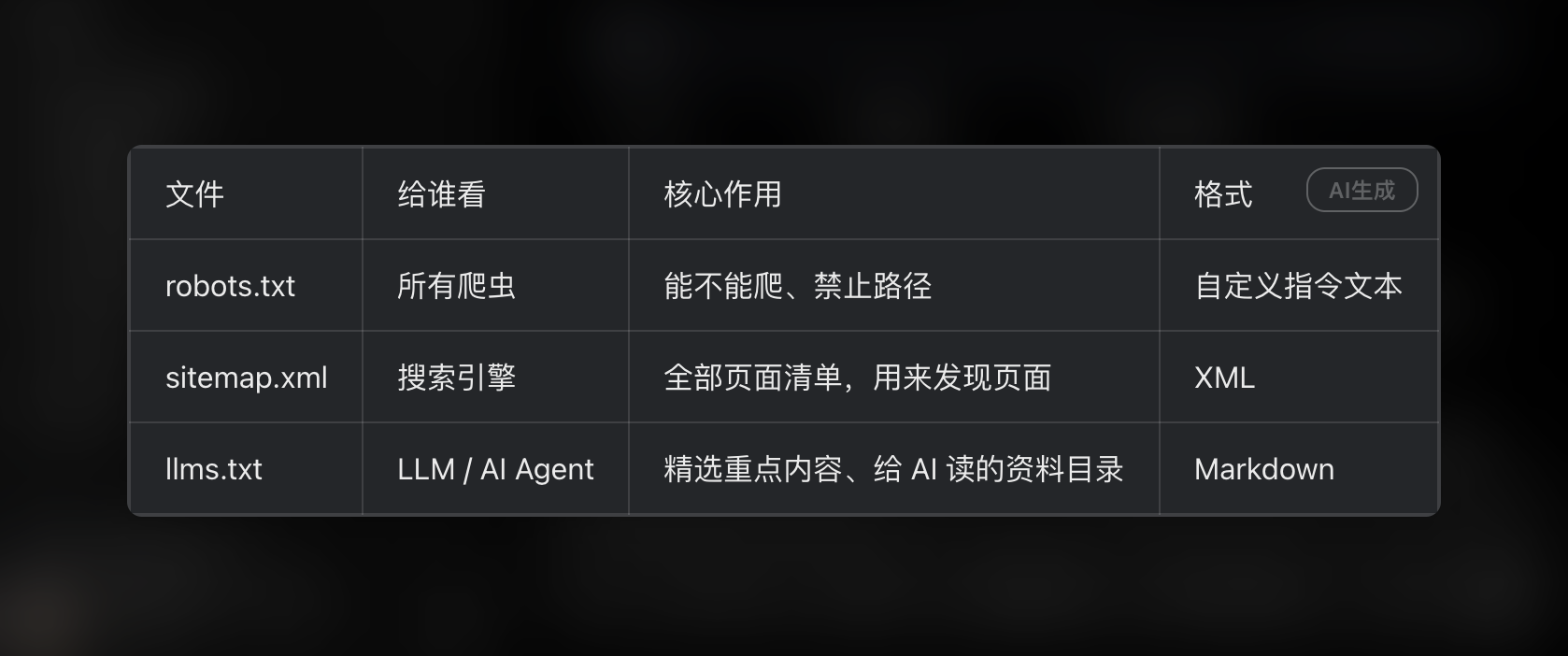
Create an llms.txt file (further optimization will depend on whether it is accessed).
llms.txt isCurated Documents for Large Models (LLMs/AI Agents) (proposed by Jeremy Howard of Answer.AI in September 2024; a community convention, not a mandatory international standard), Place a Markdown file in the site’s root directory to use a concise structure to tell the large model “what this site is about and which content is important.” It is not an official Internet standard, and there is no uniformity across vendors regarding whether their products can read it or how they choose to use it.
Our recommendation is: it’s worth a try, as the implementation cost is low, but its priority should be after the first four steps. Even after deployment, you should monitor access via logs or real-world testing; don’t mistake “file exists” for “engine has been adopted.”
Because it addresses the question of “how to enable machines to understand your site’s structure more quickly,” whereas the first four steps address whether “you even have content that can be understood.” If the foundation isn’t solid, no amount of beautiful map design will matter.
Step Six:
Replace the metrics
Traditional metrics like impressions, clicks, and rankings fail to address the questions that truly matter:“Did AI get it right when it mentioned us?”
A practical approach is to standardize a list of 30 to 50 questions, all drawn from actual customer inquiries in sales scenarios, and group them by product, use case, region, and competitive comparison. Run once a month under consistent test conditions on selected mainstream engines, recording at least the following five fields:
- Whether it is mentioned;
- Whether it has been cited (whether your link or name has been provided);
- Whether the description is accurate (positioning, parameters, regional capabilities);
- Which page was cited?
- Are competitors placed ahead of you, and what is the reasoning?
If you keep records for three consecutive months, you’ll have an “answer-layer health checkup” that lets you track changes. It also serves as a list of content topics: issues that are inaccurately described, lack sources, or have long gone unmentioned are the areas that should be prioritized for improvement in the next round of page updates.
Three Things Not to Do

Conclusion
The KPIs on the official website are quietly changing.
In the past, it was about “how many people show up”; now, it’s about whether the people and machines that come can accurately articulate who we are.
The previous metric can be purchased through ad placements,
The latter can only be built up bit by bit through its content structure.
That’s why we’ve always treated our official website as a core operational infrastructure.
Rather than a one-off vanity project.
The judgment has been verified. Next up are the fundamentals.