Our Artistic Position: Think Like an Artist
Over the past two decades, the design industry has undergone a continuous process of specialization.User research, design systems, data analysis, A/B testing, growth models… More and more methodologies are introduced into the field of design, and design is gradually evolving from a creative activity that relies on intuition and experience to a professional discipline that emphasizes logic, efficiency and verifiable results.
This change has brought many positive effects: design decisions are more rational, the design process is more standardized, and enterprises can evaluate the actual value of design through data. However, as the industry increasingly emphasizes solving problems, another problem has begun to emerge:If the design is only efficiency and optimization, will it gradually lose the ability to create new possibilities?
In today's rapid development of generative AI, this problem is particularly important.

Huan Ji FUNJI Brand Identity, Web Page, APP Design (STOYARD Project)
Design has never been just about solving problems, it's one of the most influential art forms.
Regarding the relationship between design and art, there has always been a popular view in the industry: design is responsible for solving problems, and art is responsible for expressing itself; design is rational, art is emotional; design pursues function, and art pursues expression.
But a look back at the history of design reveals that there was never a really clear border between the two.
Since the Bauhaus movement, modern design has been based on the integration of art, technology and function. Whether it is Paul Rand, Saul Bass, Milton Glaser, or Massimo Vignelli, the reason why their works can continue to influence the latecomers across the times is not only because they effectively complete a certain function, but also because they have cultural significance, emotional power and distinct creative expression at the same time.
In fact, what people remember is often not what the design solves, but how it feels.Those really great designs can not only complete the task, but also touch people's hearts.
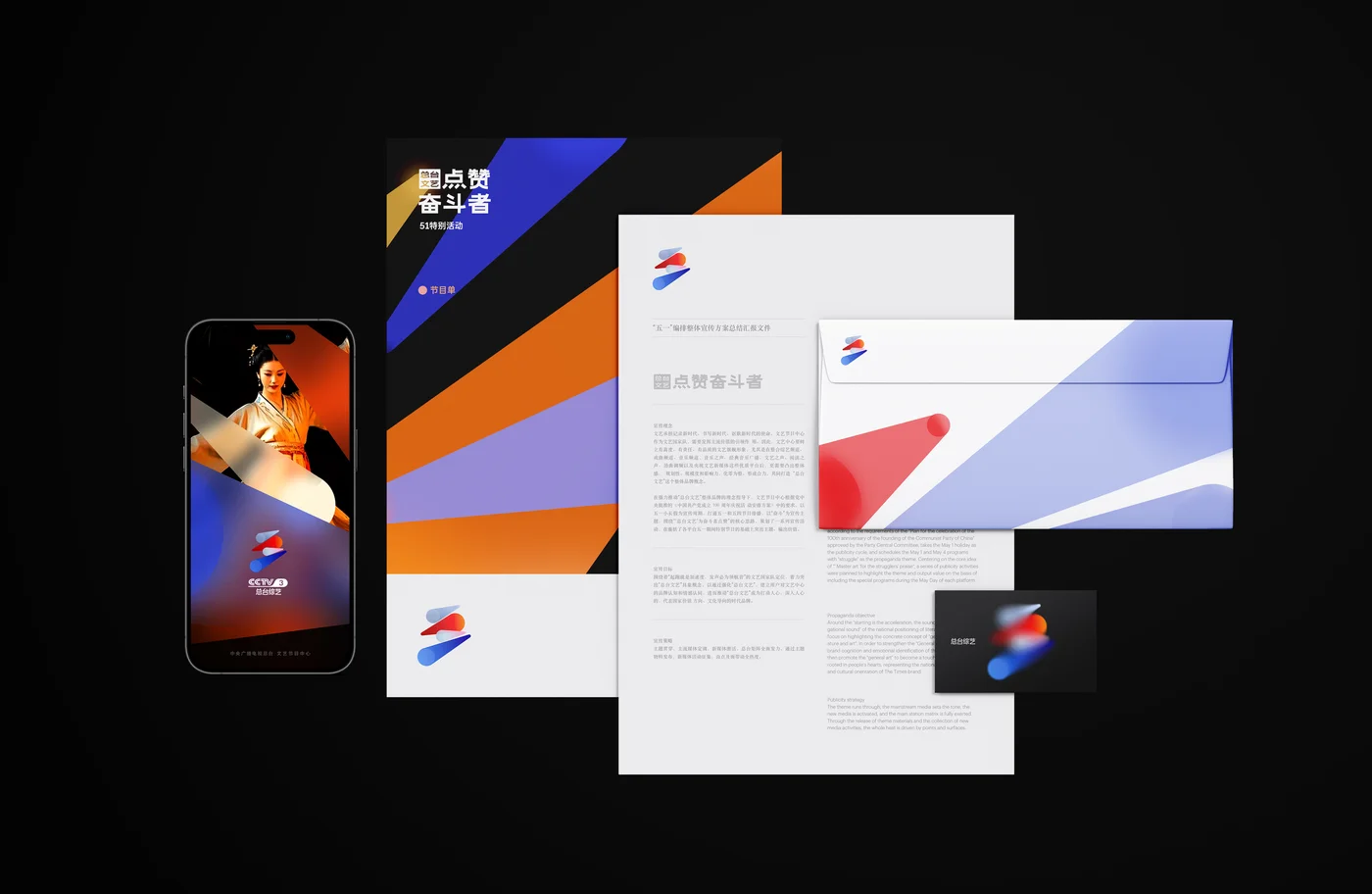
CCTV General Station Variety New Media Image Upgrade, Design Consultation (STOYARD Project)
Why are more and more designs becoming similar?
The design industry today is more dependent on data than ever before.
Companies want to reduce risk through user research, verify direction through market testing, and measure effectiveness through metrics. There is no problem with these methods themselves, they help design to establish a more scientific decision-making mechanism; but when all decisions are trying to find the safest answer, design also begins to become convergent, similar interface, similar brand expression, similar visual style more and more common. BecauseData is good at optimizing existing solutions, but it's hard to create new things that never happened.Market research can tell us what users like, but it can't tell us what they might like in the future.
Advertising guru Bill Bernbach once said: "Rules are broken by artists, and memorable works are never born of formula." In many cases, it is not the data that really drives design progress, but the bold attempts that initially seem unreasonable or even risky.
AI is accelerating the standardization of design. Where does aesthetics and individuality come from?
AI have been able to generate visual solutions, write copywriting, prototype and even code, and many tasks that used to take hours to complete can now be completed in just a few minutes, which is undoubtedly a huge efficiency revolution. However, AI's ability is essentially based on existing data: it generates new content by learning a large number of existing works, and is best at summarizing rules, refining patterns and recurring styles. In other words, AI can efficiently generate "reasonable" designs, but it is difficult to actively create expressions that do not yet exist.
If future design work relies entirely on algorithms and data, the industry is likely to enter a highly standardized stage: works will become more mature and efficient, but they may also lack personality and surprise.
That's why, as AI capabilities continue to improve,Artistic thinking has become more important.
What does artistic thinking really offer?
Artistic thinking does not mean abandoning rationality, nor does it mean rejecting commercial goals. It's more like a way of looking at the world.
Artists often actively challenge the existing cognition, question the usual rules, and try to find new ways of expression. They focus not only on how things work, but also on why things exist and whether there is another possibility. Design is never about simply executing requirements, but looking for new solutions in complex constraints; when everyone follows the same method and logic, real innovation often comes from those who are willing to break through the inertia of thinking.
The value of artistic thinking is to keep the design's ability to explore the unknown.
The most important ability of future designers is not the design ability itself.
Looking back on the development of the design industry, the value of designers is always changing: early designers rely on visual expression to establish advantages; In the Internet era, designers began to master interaction and user experience. Today, more and more executive-level work is being assisted by tools and AI. The truly essential skills are shifting toward judgment, insight, and the creation of new meaning. Designers need to understand the relationship between business, culture, technology and human nature, discover problems that others don't, and suggest new possibilities.
These abilities are difficult to be streamlined and replaced by automation, and they are highly consistent with the abilities that artists have long possessed.

STOYARD Insight
"Artistic position" is one of STOYARD core values. Over the years, we have continued to combine artistic positions with specific customer experience scenarios, collaborating deeply with design systems, growth models, data-driven design, and AI-assisted creation. These tools and methods are helping the design industry become more efficient and give design unprecedented productivity.
Efficiency is never the ultimate goal of design.
When more and more design work can be standardized and automated, designers will no longer be limited to the implementation itself. AI can help us find the most reasonable answers and generate regular designs, but it is difficult to ask questions that have never been asked before, and it is temporarily impossible to truly understand culture, emotion and human experience.